Best Smart Telescope for Deep Sky (2026): Picks for Galaxies and Nebulae
Our top picks
 Best deep-sky smart telescope for most people: 50 mm ED apo, built-in dual-band filter, EQ mode, about $999ZWO Seestar S50 Pro Smart Telescope50 mm f/5.2 · 2.45° × 1.38° · 6.2 lb8.6Price tier: Mid-rangeCheck price on Amazon
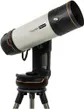 Deepest images, especially small galaxies: 152 mm f/2.2 RASA, about $4,299Celestron Origin Mark II Intelligent Home Observatory152 mm f/2.2 · 1.32° × 0.75° · 41.6 lb7.5Price tier: FlagshipCheck price
 Widest field for big nebulae and Andromeda: about 4° × 2.2°, 1.65 kg, about $664ZWO Seestar S30 Pro Smart Telescope30 mm f/5.3 · 3.99° × 2.24° · 3.6 lb8.5Price tier: Mid-rangeCheck price
 Best deep-sky value: 4K sensor, dual narrowband filter and EQ mode, about $549DWARFLAB Dwarf 3 Smart Telescope35 mm f/4.3 · 2.93° × 1.65° · 3 lb8.2Price tier: BudgetCheck price
 Most aperture for small galaxies, fully automatic: 114 mm mirror, about $2,319Unistellar eQuinox 2 Smart Telescope114 mm f/4 · 0.76° × 0.57° · 15.4 lb7.4Price tier: PremiumCheck price
The best smart telescope for deep sky is the ZWO Seestar S50 Pro for most people, and the Celestron Origin Mark II if you want the deepest galaxy images and have a backyard to leave it in. The S50 Pro (about $999) pairs 50 mm of aperture with a built-in dual-band filter for nebulae and EQ mode support for longer stacks. The Origin (about $4,299) is a 152 mm f/2.2 astrograph that pulls faint galaxies out of the dark far faster.
Galaxies and nebulae need different things, so one “best” answer isn’t enough. This guide compares five picks on aperture, focal length, sensor, field of view, filters and EQ mode, and shows what light pollution does to each. We haven’t tested these telescopes ourselves. Specs come from the makers and our model data, results are credited to named reviewers, and prices are US Amazon prices on November 12, 2026. They move often, especially during early Black Friday sales, so check today’s price before you buy.
Quick picks: best deep-sky smart telescopes
| Telescope | Aperture / f-ratio | Pixel scale | Field | Built-in filter | EQ mode | Price | Best for |
|---|---|---|---|---|---|---|---|
| Seestar S50 Pro | 50 mm f/5.2 | 2.30″ | 2.45° × 1.38° | Dual-band | TH10 head | ~$999 | Best overall |
| Origin Mark II | 152 mm f/2.2 | 1.23″ | 1.32° × 0.75° | Drawer (filter extra) | Optional wedge | ~$4,299 | Deepest images |
| Seestar S30 Pro | 30 mm f/5.3 | 3.74″ | 3.99° × 2.24° | Duo-band | TH10 + TC20 | ~$664 | Widest field |
| Dwarf 3 | 35 mm f/4.3 | 2.75″ | 2.93° × 1.65° | Dual narrowband | Tilting tripod head | ~$549 | Value |
| eQuinox 2 | 114 mm f/4 | 1.33″ | 46′ × 34′ | None (software only) | No | ~$2,319 | Small galaxies, automatic |
Pixel scale is 206.265 × pixel size (µm) ÷ focal length (mm), computed from each model’s data. Smaller numbers mean finer sampling.
What makes a smart telescope good at deep sky
Five specs decide how a smart telescope performs on faint targets. Look at these, not the megapixels.
Aperture. The lens or mirror diameter sets how much light you collect, and light grasp scales with its square. A 50 mm scope collects about 2.8 times the light of a 30 mm one, and the Origin’s 152 mm collects about 9 times the light of a 50 mm. More light means faint detail builds up in fewer minutes. How smart telescopes work covers the stacking math.
Aperture sets how faint and how sharp you can go; focal ratio sets how fast an image builds. See how smart telescopes work.
Focal length and pixel scale. A longer focal length puts more pixels across a small target. At 2.30 arcseconds per pixel, a galaxy like the Whirlpool (about 11 arcminutes long) spans roughly 290 pixels on an S50 Pro, about 175 on an S30 Pro and about 540 on the Origin. That’s why small galaxies look better on bigger scopes.
Field of view. The flip side of a long focal length is a narrow field. The Andromeda Galaxy is about 3° long, so it fits one S30 Pro frame, needs two panels on the S50 Pro and about a 3 × 2 grid on the Origin. Unistellar’s 46′ × 34′ field can’t frame it at all and has no mosaic mode.
Wider fields fit big nebulae and Andromeda; narrower fields put more pixels on small galaxies. Try any target in the framing calculator.
Filters. Emission nebulae glow in a few narrow colors, so a dual-band filter makes a huge difference from light-polluted skies. Galaxies shine across the whole spectrum, so the same filter removes their light along with the skyglow. Our filter guide explains which filter fits which scope.
Stacking and exposure limits. Smart telescopes track in alt-az by default, which makes the field slowly rotate. That caps single-exposure length and crops the corners of long stacks. EQ mode removes the rotation. ZWO quotes 60-second exposures in EQ mode on the S50 Pro, and DWARFLAB quotes 60 seconds on the Dwarf 3. Our EQ mode explainer covers the hardware.
1. Seestar S50 Pro: best smart telescope for deep sky overall
The Seestar S50 Pro is the best all-round deep-sky smart telescope because it has no weak spot for the price. ZWO uses a four-element ED apochromat at 260 mm, an 8.3 MP sensor and a 63° wide-angle camera, with a built-in dual-band filter (OIII 30 nm / H-alpha 20 nm), EQ mode support and 8K mosaics. A carbon tripod, hard case and solar filter come in the box, and ZWO rates the battery at up to 9 hours.
Its 2.45° × 1.38° field frames most of the sky’s showpieces in one shot: the Orion Nebula, the Rosette, the Whirlpool, Bode’s Galaxy and the Double Cluster. Andromeda and the Pleiades need two panels.
Pros: about 2.8 times the light of a 30 mm Seestar, filters built in, EQ mode, everything in the box. Cons: about $999, double the original S50’s last price. EQ mode needs the separately sold TH10 head (about $94). ZWO says it’s not suitable for planets. Live Science found the tripod very short, and AstroBackyard notes the battery drops in the cold.
2. Celestron Origin Mark II: deepest images
The Origin Mark II is the one to buy if faint galaxies are the whole point. It’s a 6-inch f/2.2 Rowe-Ackermann Schmidt Astrograph with autofocus, a dew heater, a filter drawer and a Sony IMX678 Starvis 2 sensor. At 335 mm and 1.23 arcseconds per pixel it puts roughly twice as many pixels across a small galaxy as an S50 Pro. Space.com found 5 to 10 minute stacks enough for crisp galaxies and picks it for deep sky in its 2026 roundup.
Our integration-time estimator puts the faint Pinwheel Galaxy at about 2.5 hours on the Origin against nearly 10 hours on an S50 Pro, from a Bortle 6 sky. That’s a planning estimate, not a measurement, but it shows the gap: one session versus a multi-night project. A free app update added mosaic capture in October 2026, according to Astronomy.com, which matters on a narrow field.
Pros: about 9 times the light of a 50 mm scope, fastest optics here, filter drawer for the Celestron Nebula filter (about $219). Cons: about $4,299 and 18.9 kg (41.6 lb) complete. BBC Sky at Night measured about 3 hours of battery near 0 °C and notes the small sensor under-uses the optics’ image circle. It has no solar option, and Space.com noted audible motors. Amazon lists a 1-year warranty.
This is a home observatory, not a travel scope. See Celestron Origin vs Seestar for the full comparison. Check the Origin Mark II price.
3. Seestar S30 Pro: widest field for big nebulae and Andromeda
The Seestar S30 Pro trades aperture for sky. Its 160 mm focal length and 4K Sony IMX585 sensor give the widest native field here, about 3.99° × 2.24°. The whole Andromeda Galaxy, the Pleiades and the California Nebula fit one frame, where the S50 Pro needs mosaics. It includes a duo-band filter, anti-dew heater, a wide camera for Milky Way panoramas and a solar filter, in a 1.65 kg body.
The physics limit is aperture: 30 mm collects about a third of the light of 50 mm, so faint galaxies take longer, and small targets such as the Horsehead look tiny at 3.74 arcseconds per pixel.
Pros: biggest field of view, light enough to carry to a dark site, about $664. Cons: less light per minute, small galaxies are small, EQ mode needs the TH10 head and TC20 tripod (about $180 as a bundle).
If you’re torn between the two Seestars, read S30 Pro vs S50 Pro. Check the S30 Pro price.
4. Dwarf 3: best deep-sky value
The Dwarf 3 pairs a 35 mm, six-element lens with a 4K Sony IMX678 Starvis 2 sensor and a dual narrowband filter (OIII 30 nm / H-alpha 15 nm) for about $549. Its field is about 2.93° × 1.65°, between the two Seestars, with a 2 × 2 mosaic mode, EQ mode on a tilting tripod head and a 60-second exposure option, all by DWARFLAB’s figures.
It’s a strong nebula machine for the money and doubles as a daytime wildlife camera. Space.com found capture time-consuming and wanted better instructions, and reviewers measured about four hours of battery, below the 5.5-hour maker figure. No tripod comes in the box.
Pros: cheapest 4K option here, narrowband filter built in, EQ mode. Cons: tripod extra, fiddlier app, less aperture than the S50 Pro.
See Dwarf 3 vs Seestar S30 Pro. Check the Dwarf 3 price.
5. Unistellar eQuinox 2: most aperture for small galaxies, automatically
The eQuinox 2 is a 114 mm Newtonian at f/4 with about 1.33 arcseconds per pixel, so it handles small galaxies, globular clusters and planetary nebulae well. It collects more than four times the light of a 50 mm scope, Unistellar rates the battery at up to 11 hours, and Space.com’s 2026 roundup names it best smart telescope overall.
The trade-offs are significant for deep sky: a narrow 46′ × 34′ field with no mosaic mode, no physical light-pollution filter (software only), manual focus and user collimation. BBC Sky at Night found images “a little soft.” Choose it for small, faint targets and shared viewing, not for big nebulae. Check the eQuinox 2 price.
Best by target: galaxies, nebulae and clusters
| Target type | What matters most | Best fit here |
|---|---|---|
| Large emission nebulae (Rosette, North America, Heart) | Wide field, dual-band filter | Seestar S30 Pro, S50 Pro, Dwarf 3 |
| Small galaxies (Whirlpool, Sombrero, M82) | Aperture, fine pixel scale | Origin Mark II, eQuinox 2 |
| Large galaxies (Andromeda, Triangulum) | Field of view, dark sky | Seestar S30 Pro, S50 Pro |
| Faint face-on galaxies (Pinwheel) | Aperture and dark sky | Origin Mark II, with patience |
| Planetary nebulae (Dumbbell, Ring) | Bright, filter-friendly; small | Any, finer scales help |
| Star clusters (M13, Double Cluster) | Easy; any field | Any |
Target sizes come from the SEDS Messier data and our tool catalog. Check how your favorite target frames on each scope in the framing calculator, and see what’s realistic from your sky with the sky target checker. For a seasonal list, see our best winter targets guide.
How to choose: a deep-sky buying guide
Decide galaxies or nebulae first. If you want colorful hydrogen clouds, a built-in dual-band filter and a wide field are worth more than aperture. If you want galaxies, favor aperture and pixel scale, and plan for dark skies.
Check the field against your targets. A wide field makes big targets easy, and a narrow one needs mosaics. A good rule: if you love Andromeda, the Pleiades and the big winter nebulae, buy for field. If you love small galaxy groups and planetary nebulae, buy for aperture.
Count the extras. Seestar and Dwarf scopes include dual-band filters and solar filters. Vaonis sells filters separately, the Origin needs a Nebula filter, and Unistellar has none. A tripod isn’t included with the Dwarf 3.
Think about EQ mode later. It’s an upgrade, not a requirement. If you may add it, Seestar, Dwarf and Origin scopes support it; Vaonis and Unistellar scopes don’t.
Be honest about where you observe. Light pollution is the largest practical limit, and it costs faint galaxies far more than bright nebulae. Our estimator puts the Pinwheel Galaxy on an S50 Pro at about 2.2 hours from Bortle 4 and about 21 hours from Bortle 8. For the Rosette from Bortle 8 with a dual-band filter, it estimates about 34 minutes on the Origin against about 2.2 hours on the S50 Pro. These are planning estimates, not measurements. Read smart telescopes in the city if you observe from town, and try the integration-time estimator with your own sky.
Match weight to your habits. The Origin is 18.9 kg with its tripod; the S30 Pro is 1.65 kg.
Also worth a look
- Vespera Pro 2 (about $2,990): a 12.5 MP square sensor at about 1.7 arcseconds per pixel, the finest sampling of any 50 mm scope here, with automatic darks and manual exposure control. It has no independent written review yet, no EQ mode and no built-in filter.
- Vespera 3 (about $2,490): new flat-field optics, an 11-hour battery and a five-year warranty. Digital Camera World saw Andromeda’s dust lanes in about ten minutes, though not in a controlled test. No EQ mode, and filters are extra.
- Unistellar Odyssey (about $2,079): 85 mm with autofocus and the finest sampling of the automatic Unistellars at about 0.93 arcseconds per pixel, but a narrow 45′ × 34′ field.
For brand-versus-brand reasoning, see Seestar vs Vespera vs Unistellar.
Who should skip a smart telescope for deep sky
- You want planets. Small smart scopes show Jupiter and Saturn as small discs. See our best smart telescope for planets guide.
- You want to look through an eyepiece. None of these picks has one. The Odyssey Pro and eVscope 2 add a Nikon electronic eyepiece, at a much higher price.
- You live under Bortle 8 to 9 skies and want faint galaxies. You can still enjoy the Moon, clusters and bright nebulae, but expect faint galaxies to take many hours.
How we chose
We ranked on what drives deep-sky results: aperture, pixel scale, field of view, filters, EQ support and portability, then value. Specs come from each maker’s page and our model data, and results are credited to named reviewers. Time estimates come from our integration-time estimator, which is guidance, not a measurement. The telescope matcher can narrow this list by budget and sky, and how we research explains our method. For the full ranking across all uses, see the best smart telescopes of 2026.
Frequently asked questions
What is the best smart telescope for deep sky imaging?
What is the best smart telescope for galaxies?
What is the best smart telescope for nebulae?
Is more aperture always better for deep-sky smart telescopes?
Do I need EQ mode for deep-sky imaging?
Can a smart telescope image galaxies from a city?
Sources
- Space.com: Celestron Origin Intelligent Home Observatory Mark II review · checked 2026-11-12 — Found 5 to 10 minute stacks enough for crisp galaxy images on the Origin Mark II; noted audible motors and a 41.6 lb complete weight.
- BBC Sky at Night: Celestron Origin Mark II review · checked 2026-11-12 — Measured about 3 h of battery near 0 °C and noted the small sensor under-uses the RASA's 22 mm image circle.
- Astronomy.com: Celestron Origin's mosaic mode brings wide-field astrophotography to the biggest smart telescope · checked 2026-11-12 — Mosaic capture arrived on the Origin in a free app update in October 2026.
- ZWO: Seestar S50 Pro product page · checked 2026-11-12 — The S50 Pro supports EQ mode with ZWO's separately sold TH10 head, with 60-second exposures in EQ mode.
- Space.com: The best smart telescopes · checked 2026-11-12 — Space.com's roundup (updated Nov 4, 2026) names the Origin Mark II best for deep sky and the S50 Pro the value choice for small budgets.
- SEDS: Messier object data table · checked 2026-11-12 — Catalog magnitudes and apparent sizes for Messier objects, the basis for the target sizes quoted in this guide.
Get new guides by e-mail
One short e-mail when Smart Telescope Review publishes a new guide. No spam, no sharing your address, and you can unsubscribe in one click.