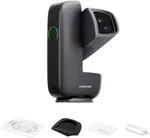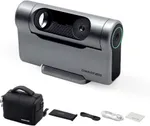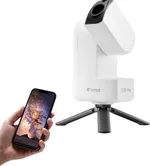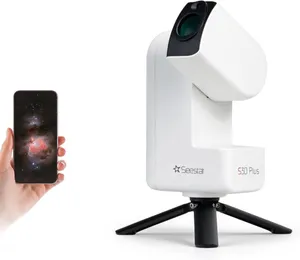
Seestar S30 Plus specs
| Brand | ZWO |
|---|---|
| Type | Smart telescope |
| Aperture | 30 mm |
| Focal length / ratio | 160 mm, f/5.3 |
| Optics | 4-element apochromatic refractor |
| Sensor | SmartSens SC485SL (1/1.8-inch), 2K output |
| Resolution | 2560 × 1440 px (3.7 MP) |
| Pixel size / scale | 2.9 µm · 3.74″ per pixel |
| Field of view | 2.66° × 1.5°. Computed from the 2560 × 1440 output at 2.9 µm (SmartSens pixel size) and 160 mm; ZWO quotes about 3° diagonal. |
| Wide-angle camera | Sony IMX586 wide-angle camera, 43.5° (2K crop) |
| Mount | Motorized alt-az + EQ mode. EQ mode with ZWO's TH10 head and TC20 tripod (sold separately); 60-second exposures only in EQ mode |
| Battery | 6,000 mAh, up to 6 h (ZWO lab figure, anti-dew off); USB-C 5 V 3 A input |
| Weight | 3.6 lb (1.65 kg). Without tripod; 210 × 140 × 80 mm |
| Storage | 64 GB |
| Filters | UV/IR-cut, duo-band (OIII 30 nm / H-alpha 20 nm) and dark filter on the telephoto camera |
| Solar | Solar filter included. Magnetic solar filter in the box |
| Mosaic mode | No. ZWO says the S30 Plus does not support wide-angle mosaic stitching; telephoto deep-sky mosaics aren't confirmed either way |
| Planets | Basic (small discs) |
| Eyepiece | No (view on phone or tablet) |
| App | Seestar app (iOS/Android) |
| Subscription | None for core features |
| Warranty | 2 years |
| Price | About $474 on Amazon (Nov 12, 2026) · $ Budget |
- ZWO's product page describes a four-element apochromatic lens without mentioning ED glass; the Amazon listing says ED glass.
- ZWO doesn't publish the S30 Plus pixel size; 2.9 µm comes from SmartSens' spec table for the SC485SL, and ZWO's 2560 × 1440 output is a crop of the native sensor.
- The original Seestar S30 is listed as discontinued by High Point Scientific, and ZWO's old S30 page now redirects to the S30 Plus.
Specs are compiled from manufacturer pages, Amazon listings and independent reviews, and may change with firmware or production runs. Confirm what's in the box (tripod, solar filter, case) on the Amazon page before buying.
ZWO Seestar S30 Plus Smart Telescope video review

Video by AstroBackyard on YouTube. Independent creator content, shown as a reference. It is not part of our scoring.
The Seestar S30 Plus is ZWO’s new entry-level smart telescope, launched on November 10, 2026 as the replacement for the original Seestar S30. It keeps the S30 Pro’s 30 mm f/5.3 four-element apochromatic lens and 1.65 kg body, swaps in a 2K SmartSens sensor, and ships with a mini tripod, a case and a magnetic solar filter. It costs about $474 on Amazon (Nov 12, 2026); check today’s price before you buy. We haven’t tested it ourselves, and because it’s two days old, nobody has published a written review yet. This page explains what’s known and where the gaps are; see how we research for our method.
Who the S30 Plus is for (and who should skip it)
It’s for first-time stargazers who want the cheapest current Seestar and a complete kit in one box: the Moon, the Sun (with the filter fitted), the Orion Nebula and bright star clusters, from a scope small enough for a backpack.
Skip it if you want the best images a 30 mm Seestar can make. The Seestar S30 Pro has a 4K sensor, a wider field and wide-angle mosaics for $190 more. Skip it too if the scope will mostly sit in the backyard: the Seestar S50 Pro collects about 2.8 times the light. And if you want planets, no 30 mm smart scope is the right tool.
Imaging in practice
There’s no independent test of the S30 Plus yet, so read this section as informed expectation, not a verdict.
The optics are shared with the S30 Pro, which reviewers have tested. BBC Sky at Night wrote that “planets are too small to show any detail, but we were able to capture Jupiter and its Galilean moons”, and Fstoppers described Jupiter as a small dot. Expect the same from the S30 Plus: the lens is identical, and so is the pixel scale (about 3.7 arcseconds per pixel), because ZWO’s 2560 × 1440 output is a crop of a sensor with the same 2.9 µm pixels.
The real difference is field of view. The crop shrinks the frame to about 2.66° × 1.5°, against roughly 4° × 2.2° on the S30 Pro. The Andromeda Galaxy fits one S30 Pro frame; on the S30 Plus its full length overflows the frame, and ZWO hasn’t confirmed telephoto mosaics on this model. Try your own targets in the FOV calculator.
The built-in duo-band filter (OIII 30 nm, H-alpha 20 nm) is the feature that matters most from suburbs. It boosts emission nebulae such as the Orion and Rosette nebulae, and does nothing for galaxies. See what’s realistic under your sky with the sky target checker.
App and workflow
The S30 Plus runs on the same Seestar app as the rest of the range, with no subscription for core features. You pick a target, the scope finds it and starts live stacking, and the picture improves on your phone as frames add up. It connects over 5 GHz or 2.4 GHz Wi-Fi.
Storage is 64 GB, of which about 45 GB is usable, so plan to offload images to your phone or computer regularly. ZWO rates the 6,000 mAh battery at up to six hours with anti-dew off; expect less on cold nights.
AstroBackyard published a video on the S30 Plus on launch day; it’s embedded on this page if you want to see the scope and app in use.
What you’ll need beyond the box
- EQ mode. Optional. ZWO recommends its TH10 head and TC20 tripod bundle (about $180), or the TH10 head and TC20 tripod separately. A Leftfoto tripod leveler makes polar alignment easier. Our EQ mode explainer covers whether you need it.
- Power. A USB-C power bank such as the Anker 737 or the cheaper UGREEN Nexode 20,000 mAh keeps you going past the internal battery.
- Solar. The filter is included. Add ISO 12312-2 eclipse glasses for your own eyes.
- Dew and travel. A Neo3D dew shield and a CASEMATIX hard case are sold for the S30 and S30 Pro; confirm S30 Plus fit before ordering.
- A red flashlight, such as the Celestron Night Vision, for finding cables in the dark.
How it compares
Hover or tap a dot for details. Full numbers are in the comparison chart.
Against the Seestar S30 Pro, you give up resolution, field and the wide-camera extras for $190 in savings. Our S30 Plus vs S30 Pro comparison goes feature by feature.
The Dwarf Mini is a little cheaper and much lighter at 840 g, but it has a 2 MP sensor and no tripod or case in the box. For more options at this price, see our best budget smart telescopes.
Bottom line
The S30 Plus is the cheapest sensible way into the Seestar system: a good lens, a duo-band filter, a solar filter and a tripod for about $474. What it lacks is a track record, so wait for the first independent reviews if you can. If you’re ready now and want the full 30 mm experience, the S30 Pro is worth the extra; if price is what matters, check the S30 Plus price on Amazon.
See what the Seestar S30 Plus can capture from your sky in the sky target checker, or frame any target in the field-of-view calculator.
Accessories for the Seestar S30 Plus
Official and compatible add-ons sold on Amazon: filters, solar filters, tripods and wedges, power banks, dew control and cases. Check the listing confirms your exact model before you buy.
- Tripod & wedgeZWO Seestar TH10 fluid tripod head (EQ mode)Official ZWO
Tilts a Seestar to your latitude for equatorial mode, which removes field rotation and allows longer, cleaner stacks. ZWO says S50-series owners need only the TH10; S30-series owners should add the TC20 tripod.
- Tripod & wedgeZWO Seestar TC20 carbon-fiber tripodOfficial ZWO
Taller, stiffer 3/8-inch tripod than the mini tripod that ships with the S30 series, rated for 66 lb. Needed with the TH10 head for EQ mode on an S30 Plus or S30 Pro.
- Tripod & wedgeZWO Seestar TH10 head + TC20 tripod bundleOfficial ZWO
Both EQ-mode pieces for the S30 series in one listing.
- SolarCelestron EclipSmart universal solar filter (75–100 mm)Universal fit
Adjustable ISO 12312-2 compliant film filter for objectives with an outside diameter of 75–100 mm, such as spotting scopes and some traditional telescopes. Too big for 30–50 mm smart scopes; use the maker's own solar filter on those.
- SolarThousand Oaks black-polymer solar filter sheet, 4 × 4 inUniversal fit
DIY solar film for making a secure full-aperture filter cell for a small scope or camera lens. Only for confident DIYers: the cell must fit tightly over the front so it can't blow off. Never use a filter at the eyepiece end.
- SolarSoluna ISO 12312-2 solar eclipse glasses (2-pack)Universal fit
For looking at the Sun with your own eyes while the scope images it; never look through a telescope with them.
- Tripod & wedgeLeftfoto tripod leveler (±5°)Compatible, third-party
Sits between tripod and head so you can level precisely for EQ-mode polar alignment without fiddling with the legs.
- PowerAnker 737 power bank, 24,000 mAh, 140 WUniversal fit
USB-C PD power bank big enough to run a 30–50 mm smart scope through a long winter night, when cold cuts battery life. Check your scope's manual for supported USB-C input while observing; Unistellar, Vaonis and Celestron Origin use their own batteries and chargers.
- PowerUGREEN Nexode 100 W power bank, 20,000 mAhUniversal fit
Cheaper USB-C PD bank that also tops up your phone, which runs the telescope's app all night.
- Dew controlNeo3D Shop dew shield and lens cover kit for Seestar S30 / S30 ProCompatible, third-party
PETG dew shield and dust cap that slow dew forming on the S30-series front glass and keep stray light out. Listed for the S30 and S30 Pro; we couldn't confirm the S30 Plus shares the same front housing.
Compatibility checked November 2026. More in our smart telescope accessories guide.
Featured in our guides
- The 7 Best Smart Telescopes of 2026: Ranked for Backyard, Travel and Budget
- Best Smart Telescope for Beginners (2026): 5 Easy Picks and a First-Night Checklist
- Best Smart Telescope for Kids (2026): 5 Family-Friendly Picks and the Solar Safety Rule
- Best Budget Smart Telescopes (2026): 4 Picks Under $700, Plus the Hidden Costs