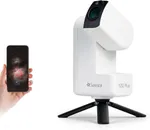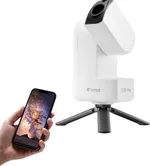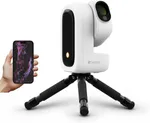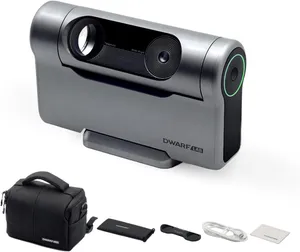
Dwarf 3 specs
| Brand | DWARFLAB |
|---|---|
| Type | Smart telescope |
| Aperture | 35 mm |
| Focal length / ratio | 150 mm, f/4.3 |
| Optics | 6-element apochromatic dual-camera lens group |
| Sensor | Sony IMX678 Starvis 2 (1/1.8-inch) |
| Resolution | 3840 × 2160 px (8.3 MP) |
| Pixel size / scale | 2 µm · 2.75″ per pixel |
| Field of view | 2.93° × 1.65°. Computed from 3840 × 2160 × 2 µm and 150 mm; DWARFLAB quotes 3.38° (diagonal). |
| Wide-angle camera | Sony IMX307 wide-angle camera, 1080p, 50.6° diagonal |
| Mount | Motorized alt-az + EQ mode. EQ mode by tilting the unit to your latitude on a tripod head (tripod not included) |
| Battery | 10,000 mAh; up to 5.5 h measured by DWARFLAB at room temperature; USB-C and external power supported |
| Weight | 3 lb (1.35 kg). 222 × 142 × 65 mm; IP54 |
| Storage | 128 GB |
| Filters | VIS, astro and dual narrowband (OIII 30 nm / H-alpha 15 nm) filters |
| Solar | Solar filter included. Magnetic solar filter included (BBC Sky at Night lists two) |
| Mosaic mode | Yes. 2 × 2 astro mosaic (4× the area) |
| Planets | Basic (small discs) |
| Eyepiece | No (view on phone or tablet) |
| App | DWARFLAB app |
| Subscription | None for core features |
| Warranty | 2 years |
| Price | About $549 on Amazon (Nov 12, 2026) · $ Budget |
- DWARFLAB doesn't state a focal ratio; f/4.3 is 150 mm ÷ 35 mm, the figure reviewers also use.
- The 2 µm native pixels can be binned 2 × 2 (4 µm) for astro work, at 1920 × 1080 output.
- BBC Sky at Night got over four hours from a charge in near-zero temperatures.
Specs are compiled from manufacturer pages, Amazon listings and independent reviews, and may change with firmware or production runs. Confirm what's in the box (tripod, solar filter, case) on the Amazon page before buying.
DWARFLAB Dwarf 3 Smart Telescope video review

Video by lukomatico on YouTube. Independent creator content, shown as a reference. It is not part of our scoring.
The Dwarf 3 is DWARFLAB’s do-everything small smart telescope: a 35 mm f/4.3 six-element apochromatic lens, a 4K Sony IMX678 Starvis 2 sensor, a wide-angle camera, built-in dual narrowband filter and a magnetic solar filter, in a 1.35 kg IP54 body that doubles as a wildlife camera. It costs about $549 on Amazon (Nov 12, 2026); check today’s price. We haven’t tested it ourselves: this review draws on BBC Sky at Night, Space.com, Digital Camera World and Astronomy.com (see how we research).
Who the Dwarf 3 is for (and who should skip it)
It’s for buyers who want one compact device for deep-sky imaging, the Moon and the Sun at night, and wildlife or landscapes by day, with 4K resolution for under $600.
Skip it if you want the simplest possible app, or a complete kit out of the box: there’s no tripod, and Space.com found capture time-consuming. Skip it also if you want the widest field in a small scope; the Seestar S30 Pro frames more sky.
Imaging in practice
BBC Sky at Night gave the Dwarf 3 four stars. Its 35 mm aperture gathers about a third more light than the 30 mm scopes it competes with, and the 2 µm pixels give finer sampling (about 2.75 arcseconds per pixel) than the 30 mm Seestars. For astro work the pixels can be binned 2 × 2, giving 1920 × 1080 output.
Planets are the weak spot. Astronomy.com says the 150 mm focal length is too short for detailed planetary images, and Space.com found planets weren’t crisp. Jupiter comes out about 16 pixels across.
The field is about 2.93° × 1.65°. That’s slightly too short for the full length of the Andromeda Galaxy, which needs two panels; DWARFLAB’s 2 × 2 mosaic mode covers four times the area. Plan targets in the FOV calculator.
The built-in dual narrowband filter (OIII 30 nm, H-alpha 15 nm) is what makes emission nebulae work from suburbs. DWARFLAB claims 60-second exposures in EQ mode, where you tilt the unit to your latitude on a tripod head. Check your sky in the sky target checker.
App and workflow
The DWARFLAB app has no subscription for core features. In our reading of the reviews it’s fiddlier than ZWO’s Seestar app: Space.com called image capture time-consuming and wanted better instructions.
Battery life lands below the maker figure. DWARFLAB measured up to 5.5 hours at room temperature from the 10,000 mAh pack; Digital Camera World got about four, and BBC Sky at Night got over four hours in near-zero temperatures. External USB-C power is supported, and storage is 128 GB.
What you’ll need beyond the box
- A tripod. The DWARFLAB mini tripod with hydraulic head (about $89) is the easy route to EQ mode. See our EQ mode explainer.
- Dew and focus masks. The MASK PRO starter kit adds a magnetic dew shield plus Bahtinov and diffraction-spike masks made for the Dwarf 3.
- Extra filters (optional). The M48 adapter with 2-inch filter mount takes standard filters such as the Optolong L-eXtreme, L-eNhance or L-Pro. It’s a new third-party part with no reviews yet when we checked.
- Power and a case. A USB-C bank such as the Anker 737, and the USA Gear case for the scope, tripod and battery.
- Solar. The filter is included; read our guide to photographing the Sun before you start.
How it compares
Hover or tap a dot for details. Full numbers are in the comparison chart.
The Seestar S30 Pro costs about $115 more, has a wider field, a smoother app, a mini tripod in the box and 8K Milky Way stitching; the Dwarf 3 counters with more aperture and stronger daytime tools. Our Dwarf 3 vs Seestar S30 Pro comparison covers it in detail.
The Dwarf Mini is lighter and cheaper but has a 2 MP sensor. The Seestar S50 Pro is the step up if you want more aperture for the backyard.
Bottom line
The Dwarf 3 is the most versatile small smart telescope: 4K, filtered, weather-resistant and useful in daylight too, for about $549. Budget for a tripod and expect about four hours on a cold night. Check the Dwarf 3 price on Amazon.
See what the Dwarf 3 can capture from your sky in the sky target checker, or frame any target in the field-of-view calculator.
Accessories for the Dwarf 3
Official and compatible add-ons sold on Amazon: filters, solar filters, tripods and wedges, power banks, dew control and cases. Check the listing confirms your exact model before you buy.
- Tripod & wedgeDWARFLAB mini tripod with hydraulic headOfficial DWARFLAB
Compact 1/4-inch tripod with a tilting hydraulic head, the simple way to set the Dwarf 3 or Dwarf Mini up for EQ mode. Rated for 3 kg (6.6 lb).
- SolarCelestron EclipSmart universal solar filter (75–100 mm)Universal fit
Adjustable ISO 12312-2 compliant film filter for objectives with an outside diameter of 75–100 mm, such as spotting scopes and some traditional telescopes. Too big for 30–50 mm smart scopes; use the maker's own solar filter on those.
- SolarThousand Oaks black-polymer solar filter sheet, 4 × 4 inUniversal fit
DIY solar film for making a secure full-aperture filter cell for a small scope or camera lens. Only for confident DIYers: the cell must fit tightly over the front so it can't blow off. Never use a filter at the eyepiece end.
- SolarSoluna ISO 12312-2 solar eclipse glasses (2-pack)Universal fit
For looking at the Sun with your own eyes while the scope images it; never look through a telescope with them.
- FilterOptolong L-eXtreme 7 nm dual narrowband filter (2-inch)Compatible, third-party
Tight 7 nm H-alpha and OIII passbands: the go-to filter for nebulae from heavily light-polluted skies. Needs a 2-inch adapter: the S50 Pro adapter above or an M48 adapter for the Dwarf 3. Only useful on emission nebulae.
- FilterOptolong L-eNhance dual narrowband filter (2-inch)Compatible, third-party
Wider tri-band (H-alpha, H-beta, OIII) filter: brighter stars and shorter exposures than the L-eXtreme, with a little less contrast in bright cities. Needs a 2-inch adapter; for one-shot-color cameras.
- FilterOptolong L-Pro broadband light-pollution filter (2-inch)Compatible, third-party
Broadband filter for galaxies and star clusters under moderate suburban skies, where narrowband filters don't help. Needs a 2-inch adapter.
- FilterZTMXHYKH M48 thread adapter with 2-inch filter mount for Dwarf 3Compatible, third-party
Lets the Dwarf 3 take standard 2-inch filters and doubles as a lens hood and dew shield. Third-party part from a marketplace seller with no reviews yet when we checked; the Dwarf 3 already ships with its own magnetic filter.
- PowerAnker 737 power bank, 24,000 mAh, 140 WUniversal fit
USB-C PD power bank big enough to run a 30–50 mm smart scope through a long winter night, when cold cuts battery life. Check your scope's manual for supported USB-C input while observing; Unistellar, Vaonis and Celestron Origin use their own batteries and chargers.
- PowerUGREEN Nexode 100 W power bank, 20,000 mAhUniversal fit
Cheaper USB-C PD bank that also tops up your phone, which runs the telescope's app all night.
Compatibility checked November 2026. More in our smart telescope accessories guide.
Featured in our guides
- The 7 Best Smart Telescopes of 2026: Ranked for Backyard, Travel and Budget
- Best Smart Telescope for Deep Sky (2026): Picks for Galaxies and Nebulae
- Best Smart Telescope for Beginners (2026): 5 Easy Picks and a First-Night Checklist
- Best Smart Telescope for Kids (2026): 5 Family-Friendly Picks and the Solar Safety Rule