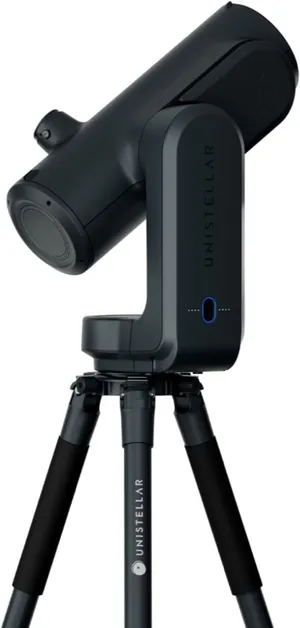
Odyssey Pro specs
| Brand | Unistellar |
|---|---|
| Type | Smart telescope |
| Aperture | 85 mm |
| Focal length / ratio | 320 mm, f/3.9 |
| Optics | 85 mm Newtonian reflector (Nikon optics), autofocus, no collimation |
| Sensor | Sony IMX415 (per BBC Sky at Night) |
| Pixel size / scale | 1.45 µm · 0.93″ per pixel |
| Field of view | 0.75° × 0.56°. Unistellar figure: 45 × 33.6 arcminutes. |
| Mount | Motorized alt-az. No EQ mode |
| Battery | Up to 5 h (Unistellar; BBC Sky at Night agrees); USB-A port can charge a phone |
| Weight | 8.8 lb (4 kg). Maker: 4 kg; Digital Camera World lists 5 kg. Tripod 5.5 lb |
| Storage | 64 GB |
| Filters | None; software light-pollution reduction ('Deep Dark Technology') |
| Solar | Optional solar filter. Smart Solar Filter sold separately (about $199); held on by magnets (BBC) |
| Mosaic mode | No |
| Planets | Basic (small discs) |
| Eyepiece | Nikon electronic OLED eyepiece showing the live stacked image |
| App | Unistellar app (iOS/Android), with NASA/SETI citizen-science campaigns |
| Subscription | None found: the app is free with no in-app purchases listed |
| Warranty | 2 years |
| Price | About $3,679 on Amazon (Nov 12, 2026) · $$$$ Flagship |
- Unistellar lists 4 kg; Digital Camera World lists 5 kg, and Space.com weighed scope plus tripod at 13.2 lb.
- Digital Camera World found Jupiter blurred but allowed that atmospheric seeing may have been to blame.
Amazon listings and bundles
Each option is a separate Amazon listing. Prices are typical street prices, not live.
| Option | What's different | Price |
|---|---|---|
| Odyssey Pro (black) | Telescope, tripod and Nikon eyepiece | Check price |
| Odyssey Pro (red) | Same telescope in red | Check price |
Specs are compiled from manufacturer pages, Amazon listings and independent reviews, and may change with firmware or production runs. Confirm what's in the box (tripod, solar filter, case) on the Amazon page before buying.
Unistellar Odyssey Pro Smart Telescope video review

Video by Maximum Astronomy on YouTube. Independent creator content, shown as a reference. It is not part of our scoring.
The Unistellar Odyssey Pro is the smart telescope for people who miss looking through an eyepiece. It pairs Unistellar’s 85 mm autofocus Newtonian with a Nikon electronic OLED eyepiece that shows the live stacked image. It costs about $3,679 on Amazon (Nov 12, 2026) against a $4,599 list, in black or red, so check today’s price. We haven’t tested it ourselves; what follows is drawn from named reviews and Unistellar’s own figures.
Who it’s for (and who should skip it)
It’s for outreach volunteers, astronomy clubs, star-party regulars and families who want people to put an eye to the telescope rather than crowd around a phone. Space.com’s 2026 roundup names it the most versatile smart telescope, and the eyepiece is the reason.
Skip it if your goal is photographs. As an imager it is the same narrow-field scope as the Unistellar Odyssey, which costs about $2,079, so you’d be paying about $1,600 for the viewing experience. Maximum Astronomy’s in-depth video review reaches the same conclusion: best for outreach, not for astrophotography.
Imaging and viewing in practice
BBC Sky at Night (Paul Money) rated it 4.5 out of 5. The magazine liked the practical touches: magnets hold the dust cap and the optional solar filter in place, battery life ran to about 5 hours, and a USB-A port can charge your phone.
Digital Camera World also gave it 4.5 out of 5, but found Jupiter blurred and allowed that atmospheric seeing may have been to blame. Space.com reports that early units shipped defocused and were recalled, notes that the scope doesn’t park when switched off, and calls the Odyssey line not ideal for planets.
Output is about 4.1 MP (Space.com and DCW), and the field is 45 × 33.6 arcminutes. That’s tight: the Andromeda Galaxy would take about a 5 × 3 grid of frames, and Unistellar has no mosaic mode. Small galaxies, globular clusters and planetary nebulae are where it shines. Try your targets in the FOV calculator and check what’s up tonight with the sky target checker.
App and workflow
The workflow matches the Odyssey’s. Autofocus and no collimation mean you level, power on, connect the free Unistellar app and pick a target. Light pollution is reduced in software (Deep Dark Technology) because there’s no physical filter. Stacking starts immediately, and the image deepens on your phone and in the eyepiece at the same time.
There’s no subscription that we could find, and the app includes NASA and SETI citizen-science campaigns. The mount is alt-az only, with no EQ mode. Unistellar lists a 2-year warranty. Weight is 4 kg by Unistellar’s figure, 5 kg in DCW’s spec table, and Space.com weighed scope plus tripod at 13.2 lb.
What you’ll need beyond the box
- Solar filter. The Smart Solar Filter is sold separately (about $199) and, per BBC Sky at Night, attaches magnetically. Don’t substitute generic film on this scope. For naked-eye viewing during the session, use ISO 12312-2 eclipse glasses, never through the eyepiece.
- A case. The Unistellar backpack for Odyssey and Odyssey Pro is cabin size and holds the scope and tripod.
- Phone power. The scope’s USB-A port helps, but on long outreach nights an Anker 24,000 mAh power bank keeps several phones going.
- A red light. A red LED flashlight is essential at star parties, where white light annoys everyone.
More options are on our accessories page.
How it compares
The eVscope 2 is the other eyepiece model: 114 mm of aperture and a 7.7 MP output (Unistellar), but manual focus, collimation and about $3,999. For images rather than views, a Vespera 3 offers a much wider field with mosaics for about $2,490. Our Seestar vs Vespera vs Unistellar comparison weighs the three systems, and smart vs traditional telescopes explains what an electronic eyepiece does and doesn’t give you.
Bottom line
The Odyssey Pro is a lovely outreach instrument: easy to run, pleasant to look into, and backed by a free science program. As a camera it’s no better than the cheaper Odyssey. If sharing the view at the eyepiece matters most, check the price on Amazon.
See what the Odyssey Pro can capture from your sky in the sky target checker, or frame any target in the field-of-view calculator.
Accessories for the Odyssey Pro
Official and compatible add-ons sold on Amazon: filters, solar filters, tripods and wedges, power banks, dew control and cases. Check the listing confirms your exact model before you buy.
- CaseUnistellar transportation backpack for Odyssey and Odyssey ProOfficial Unistellar
Airline cabin-size backpack (55 × 38.5 × 16 cm) with foam that holds the Odyssey and its tripod.
- SolarCelestron EclipSmart universal solar filter (75–100 mm)Universal fit
Adjustable ISO 12312-2 compliant film filter for objectives with an outside diameter of 75–100 mm, such as spotting scopes and some traditional telescopes. Too big for 30–50 mm smart scopes; use the maker's own solar filter on those.
- SolarThousand Oaks black-polymer solar filter sheet, 4 × 4 inUniversal fit
DIY solar film for making a secure full-aperture filter cell for a small scope or camera lens. Only for confident DIYers: the cell must fit tightly over the front so it can't blow off. Never use a filter at the eyepiece end.
- SolarSoluna ISO 12312-2 solar eclipse glasses (2-pack)Universal fit
For looking at the Sun with your own eyes while the scope images it; never look through a telescope with them.
- PowerAnker 737 power bank, 24,000 mAh, 140 WUniversal fit
USB-C PD power bank big enough to run a 30–50 mm smart scope through a long winter night, when cold cuts battery life. Check your scope's manual for supported USB-C input while observing; Unistellar, Vaonis and Celestron Origin use their own batteries and chargers.
- PowerUGREEN Nexode 100 W power bank, 20,000 mAhUniversal fit
Cheaper USB-C PD bank that also tops up your phone, which runs the telescope's app all night.
- ObservingCelestron Night Vision red LED flashlightUniversal fit
Dimmable red light keeps your dark adaptation for finding cables, levels and the tripod at night.
Compatibility checked November 2026. More in our smart telescope accessories guide.
Featured in our guides
- Smart Telescope Gift Guide 2026: The Best Picks at Every Budget, Plus Stocking Stuffers
- Seestar vs Vespera vs Unistellar: Which Smart Telescope Brand Fits You?
- Celestron Origin Mark II vs Unistellar Odyssey Pro: Which $4,000 Smart Telescope Wins?
- Smart Telescope vs Traditional Telescope: Which Should You Buy?