Smart telescope comparison chart

Every smart telescope we track, plus two phone-guided traditional scopes for contrast, side by side: aperture, focal length, native field of view, mount, weight and battery. Click any column to sort by it. Covers 15 models from Celestron, DWARFLAB, Unistellar, Vaonis, ZWO.

Smart telescopes, sorted by score (click headers to re-sort)
ModelScoreApertureFocal lengthField of viewMountWeightBatteryPrice tierBuy
ZWO Seestar S50 Pro Smart Telescope8.650 mm260 mm (f/5.2)2.45° × 1.38°Motorized alt-az + EQ mode6.2 lb9 hPrice tier: Mid-rangeCheck price of the ZWO Seestar S50 Pro Smart Telescope on Amazon
ZWO Seestar S30 Pro Smart Telescope8.530 mm160 mm (f/5.3)3.99° × 2.24°Motorized alt-az + EQ mode3.6 lb6 hPrice tier: Mid-rangeCheck price of the ZWO Seestar S30 Pro Smart Telescope on Amazon
ZWO Seestar S30 Plus Smart Telescope8.230 mm160 mm (f/5.3)2.66° × 1.5°Motorized alt-az + EQ mode3.6 lb6 hPrice tier: BudgetCheck price of the ZWO Seestar S30 Plus Smart Telescope on Amazon
DWARFLAB Dwarf 3 Smart Telescope8.235 mm150 mm (f/4.3)2.93° × 1.65°Motorized alt-az + EQ mode3 lb5.5 hPrice tier: BudgetCheck price of the DWARFLAB Dwarf 3 Smart Telescope on Amazon
Vaonis Vespera 3 Smart Telescope8.150 mm245 mm (f/4.9)2.6° × 1.4°Motorized alt-az11 lb11 hPrice tier: PremiumCheck price of the Vaonis Vespera 3 Smart Telescope on Amazon
Vaonis Vespera Pro 2 Smart Telescope8.150 mm245 mm (f/4.9)1.6° × 1.6°Motorized alt-az11 lb11 hPrice tier: PremiumCheck price of the Vaonis Vespera Pro 2 Smart Telescope on Amazon
DWARFLAB Dwarf Mini Smart Telescope7.830 mm150 mm (f/5)2.13° × 1.2°Motorized alt-az + EQ mode1.9 lb4 hPrice tier: BudgetCheck price of the DWARFLAB Dwarf Mini Smart Telescope on Amazon
Unistellar Odyssey Smart Telescope7.685 mm320 mm (f/3.9)0.75° × 0.56°Motorized alt-az8.8 lb5 hPrice tier: PremiumCheck price of the Unistellar Odyssey Smart Telescope on Amazon
Vaonis Vespera II Smart Telescope7.550 mm250 mm (f/5)2.5° × 1.4°Motorized alt-az11 lb4 hPrice tier: PremiumCheck price of the Vaonis Vespera II Smart Telescope on Amazon
Unistellar Odyssey Pro Smart Telescope7.585 mm320 mm (f/3.9)0.75° × 0.56°Motorized alt-az8.8 lb5 hPrice tier: FlagshipCheck price of the Unistellar Odyssey Pro Smart Telescope on Amazon
Celestron Origin Mark II Intelligent Home Observatory7.5152 mm335 mm (f/2.2)1.32° × 0.75°Motorized alt-az41.6 lb6 hPrice tier: FlagshipCheck price of the Celestron Origin Mark II Intelligent Home Observatory on Amazon
Celestron StarSense Explorer DX 130AZ7.5130 mm650 mm (f/5)2.0° × 2.0° (eyepiece)Manual alt-az18 lbNone neededPrice tier: BudgetCheck price of the Celestron StarSense Explorer DX 130AZ on Amazon
Unistellar eQuinox 2 Smart Telescope7.4114 mm450 mm (f/4)0.76° × 0.57°Motorized alt-az15.4 lb11 hPrice tier: PremiumCheck price of the Unistellar eQuinox 2 Smart Telescope on Amazon
Unistellar eVscope 2 Smart Telescope7.3114 mm450 mm (f/4)0.76° × 0.57°Motorized alt-az15.4 lb9 hPrice tier: FlagshipCheck price of the Unistellar eVscope 2 Smart Telescope on Amazon
Celestron StarSense Explorer LT 114AZ6.9114 mm1000 mm (f/8.8)1.3° × 1.3° (eyepiece)Manual alt-az10.4 lbNone neededPrice tier: BudgetCheck price of the Celestron StarSense Explorer LT 114AZ on Amazon

Field of view is the main camera's native frame (smart scopes) or the true field with the widest included eyepiece (phone-guided scopes). Battery is the maker's claim; reviewers usually measure less in the cold. See the framing calculator and how smart telescopes work.

Specs are manufacturer figures from spec sheets and Amazon listings; fields of view are computed from sensor size and focal length where the maker gives only a diagonal. Prices are US Amazon prices on November 12, 2026 and change often.

Value, field of view and aperture at a glance

Score vs. Amazon priceEach dot is one telescope: our research-based score against its Amazon price on Nov 12, 2026 (price axis compressed). Further right and lower is better value.

Hover or tap a dot for details. Full numbers are in the comparison chart.

Native field of viewHow much sky the main camera frames in one shot (bar length = area in square degrees). The full Moon is about 0.5° across.

Wider fields fit big nebulae and Andromeda; narrower fields put more pixels on small galaxies. Try any target in the framing calculator.

Highest-rated smart telescopes

#1 · Top rated
ZWO Seestar S50 Pro Smart Telescope
  • 50 mm f/5.2
  • 2.45° × 1.38° field
  • 6.2 lb
  • EQ mode
  • Dual-band filter

Most buyers: the best all-round smart telescope for backyard deep-sky imaging, the Moon and the Sun at under $1,000, and the direct replacement for the discontinued Seestar S50.

  • 50 mm four-element ED apochromat collects about 2.8× the light of the 30 mm Seestars
  • 8.3 MP main sensor plus a 63° wide camera, dual-band filter and 128 GB storage
  • Up to 9 h battery (ZWO), hard case, carbon tripod and solar filter included
  • $999 list, double the original S50's last price
Price tier: Mid-rangeAmazon price, Nov 12, 2026
#2 · Top rated
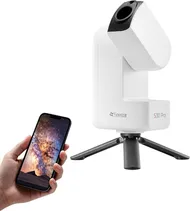
ZWO Seestar S30 Pro Smart Telescope
  • 30 mm f/5.3
  • 3.99° × 2.24° field
  • 3.6 lb
  • EQ mode
  • Dual-band filter

Travelers and beginners who want the most capable ultra-portable smart telescope: wide nebulae, the Milky Way, the Moon and the Sun from a 1.65 kg scope.

  • 4K Sony IMX585 telephoto sensor and a 4K, 63° wide camera in a 1.65 kg body
  • Widest native field here (about 4° × 2.2°): large nebulae and the Andromeda Galaxy fit without a mosaic
  • Built-in duo-band filter, dark filter, anti-dew heater and an included solar filter
  • 30 mm aperture and 160 mm focal length: ZWO itself says it's not intended for planets
Price tier: Mid-rangeAmazon price, Nov 12, 2026
#3 · Top rated
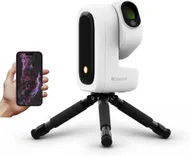
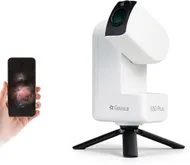
ZWO Seestar S30 Plus Smart Telescope
  • 30 mm f/5.3
  • 2.66° × 1.5° field
  • 3.6 lb
  • EQ mode
  • Dual-band filter

First-time stargazers who want the cheapest current Seestar, with a solar filter, case and tripod in the box, for the Moon, the Sun and bright nebulae and clusters.

  • $474 for a complete kit: telescope, mini tripod, protective case and a magnetic solar filter
  • Built-in duo-band (H-alpha/OIII) filter for emission nebulae from light-polluted skies
  • Same 30 mm f/5.3 four-element apochromatic lens and 1.65 kg body as the S30 Pro
  • 2K (1440 × 2560) telephoto output versus the S30 Pro's 4K sensor
Price tier: BudgetAmazon price, Nov 12, 2026
#4 · Top rated
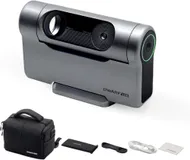
DWARFLAB Dwarf 3 Smart Telescope
  • 35 mm f/4.3
  • 2.93° × 1.65° field
  • 3 lb
  • EQ mode
  • Dual-band filter

Owners who want one compact device for deep-sky imaging, the Moon and Sun, and daytime wildlife or landscape photography, with 4K resolution under $600.

  • 4K Sony IMX678 telephoto plus a wide-angle camera in a 1.35 kg, IP54 body
  • Built-in dual narrowband filter and an included magnetic solar filter
  • EQ mode, 60-second exposures and a 2 × 2 mosaic mode (maker claims)
  • No tripod in the box (Digital Camera World lists it as a con)
Price tier: BudgetAmazon price, Nov 12, 2026
#5 · Top rated
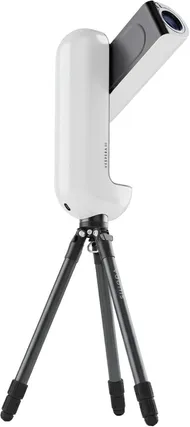
Vaonis Vespera 3 Smart Telescope
  • 50 mm f/4.9
  • 2.6° × 1.4° field
  • 11 lb

Buyers who want premium optics, an all-night battery, multi-night projects and a five-year warranty, and don't need EQ mode or planets.

  • New flat-field apochromatic quadruplet with stray-light baffles (Vaonis)
  • 11 h battery, 128 GB storage (115 GB usable) and automatic anti-fog
  • Automatic multi-night capture: frame once and resume stacking on later nights
  • $2,490 for the same IMX585 sensor the $999 Seestar S50 Pro class uses
Price tier: PremiumAmazon price, Nov 12, 2026
#6 · Top rated
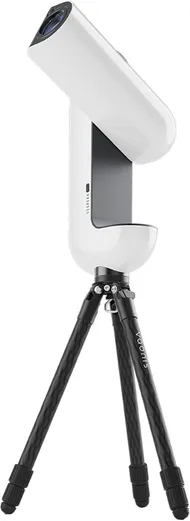
Vaonis Vespera Pro 2 Smart Telescope
  • 50 mm f/4.9
  • 1.6° × 1.6° field
  • 11 lb

Detail-hungry imagers who want the sharpest 50 mm smart telescope, automatic darks, manual control and a five-year warranty.

  • 12.5 MP square IMX676 sensor at about 1.7″ per pixel: the finest sampling of any 50 mm scope here
  • Automatic master darks and BalENS gradient removal (Vaonis)
  • Manual exposure (1–30 s) and gain, FITS/TIFF export, 50 MP mosaics and multi-night projects
  • $2,990: three times the Seestar S50 Pro
Price tier: PremiumAmazon price, Nov 12, 2026

How to read this chart

Aperture is the lens or mirror diameter: it sets how much light the scope collects and how fine a detail it can resolve. Focal length and the focal ratio after it decide image scale and speed: short, fast optics (f/2–f/5) build deep-sky images quickly, while long focal lengths are what planets need. Field of view is how much sky fits in one frame; compare it with your targets in the framing calculator. Mount tells you whether there's an EQ (equatorial) mode for longer, rotation-free exposures. Weight and battery decide whether it travels. Not sure what fits? The telescope matcher narrows the list, and the sky target checker shows what each scope can capture from your sky.

FAQ

Which smart telescope scores highest in 2026?
By our research-based score, the ZWO Seestar S50 Pro Smart Telescope currently ranks highest (8.6/10), but the right telescope depends on your sky, your targets, whether you travel and your budget. Sort the table by the spec that matters most, or use the telescope matcher.
Is a bigger aperture always better in a smart telescope?
For faint, small targets, yes: a 114 mm mirror collects about five times the light of a 50 mm lens. But field of view matters as much. Narrow-field scopes like the Unistellar Odyssey can't fit the Andromeda Galaxy or big nebulae in one frame, while 30–50 mm Seestars and Dwarfs frame them easily. Focal ratio decides how fast an image builds.
What does the field of view column mean?
It's how much sky the main camera captures in one frame, in degrees. The full Moon is about 0.5° across. A 2.5° × 1.4° field fits the Orion Nebula with room to spare; a 0.75° × 0.56° field is better for small galaxies and planetary nebulae. The framing calculator shows any target inside every scope's frame.
Are the phone-guided StarSense telescopes smart telescopes?
No. They're traditional manual telescopes with a phone dock that plate-solves the sky and points you to targets; you look through an eyepiece and nothing is stacked or photographed. We include them as a different category because they show planets far better than small smart scopes, at a lower price.