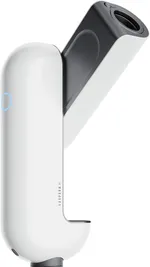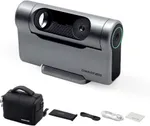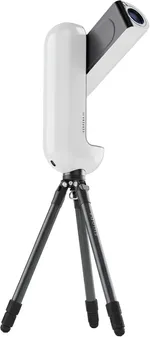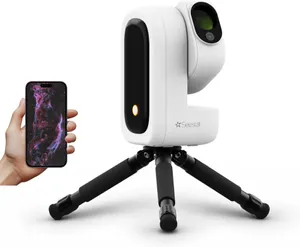
Seestar S50 Pro specs
| Brand | ZWO |
|---|---|
| Type | Smart telescope |
| Aperture | 50 mm |
| Focal length / ratio | 260 mm, f/5.2 |
| Optics | 4-element apochromatic refractor with ED glass |
| Sensor | OmniVision OS08B10 (1/1.2-inch) |
| Resolution | 3840 × 2160 px (8.3 MP) |
| Pixel size / scale | 2.9 µm · 2.30″ per pixel |
| Field of view | 2.45° × 1.38°. Computed from 3840 × 2160 × 2.9 µm and 260 mm; ZWO quotes 2.8° (diagonal). |
| Wide-angle camera | Sony IMX586 wide-angle camera, 8.3 MP, 63° |
| Mount | Motorized alt-az + EQ mode. EQ mode with ZWO's TH10 head (sold separately; bundles available); 60-second exposures in EQ mode |
| Battery | 10,000 mAh, up to 9 h (ZWO lab figure above 25 °C, app v3.3.1; first quoted as 7 h); USB-C 5 V 3 A or 12 V 3 A |
| Weight | 6.2 lb (2.8 kg). Live Science weighed its sample at 2.7 kg |
| Storage | 128 GB |
| Filters | UV/IR-cut, dual-band (OIII 30 nm / H-alpha 20 nm) and dark filter |
| Solar | Solar filter included. Solar filter, hard case and carbon tripod in the box |
| Mosaic mode | Yes. Deep-sky mosaics up to 8K, plus 8K Milky Way Arch with the wide camera |
| Planets | Not recommended by maker |
| Eyepiece | No (view on phone or tablet) |
| App | Seestar app (iOS/Android) |
| Subscription | None for core features; 'Telescope Network' remote access is a free beta trial |
| Warranty | 2 years (AstroBackyard reports 1 year on the battery) |
| Price | About $999 on Amazon (Nov 12, 2026) · $$ Mid-range |
- ZWO lists the main sensor as an OmniVision OS08B10 (1/1.2-inch, 2.9 µm); Digital Camera World describes it as 1/1.25-inch. AstroBackyard notes the switch away from Sony 'has caused controversy'.
- Launched August 25, 2026. Astronomy.com reported an $899 introductory price and $999 list from September 15.
- Two Amazon listings were live at $999 on Nov 12, 2026: ZWO Store and Agena Astro.
Amazon listings and bundles
Each option is a separate Amazon listing. Prices are typical street prices, not live.
| Option | What's different | Price |
|---|---|---|
| Seestar S50 Pro | Telescope, carbon tripod, hard case, solar filter (sold by ZWO Store) | Check price |
| Seestar S50 Pro (Agena Astro listing) | Same telescope from an authorized astronomy dealer | Check price |
Specs are compiled from manufacturer pages, Amazon listings and independent reviews, and may change with firmware or production runs. Confirm what's in the box (tripod, solar filter, case) on the Amazon page before buying.
ZWO Seestar S50 Pro Smart Telescope video review

Video by AstroBackyard on YouTube. Independent creator content, shown as a reference. It is not part of our scoring.
The Seestar S50 Pro is ZWO’s 50 mm smart telescope and the replacement for the best-selling Seestar S50. It pairs a four-element ED apochromat (260 mm, f/5.2) with an 8.3 MP OmniVision sensor, adds a 63° wide-angle camera, and ships with a carbon tripod, hard case and solar filter. It costs about $999 on Amazon (Nov 12, 2026) from both ZWO’s store and Agena Astro; check today’s price. Space.com’s 2026 roundup names it the value pick for small budgets. We haven’t tested it ourselves: this review draws on Digital Camera World, Live Science and AstroBackyard (see how we research).
Who the S50 Pro is for (and who should skip it)
It’s for most people buying a first serious smart telescope: backyard galaxies and nebulae, the Moon and the Sun, with enough portability to take to a darker site. If you were waiting for an S50 restock, this is what replaced it; our Seestar S50 discontinued guide explains the change.
Skip it if you fly often or hike to observe: at 2.8 kg (Live Science weighed 2.7 kg), it’s heavier than the 1.65 kg Seestar S30 Pro. Skip it too if planets are your priority, because ZWO says it isn’t suitable for them.
Imaging in practice
The 50 mm aperture collects about 2.8 times the light of the 30 mm Seestars, which shows up as faster, cleaner stacks on faint targets. Digital Camera World called it versatile, with impressive imaging capabilities for a two-camera smart telescope.
The sensor is the controversial part. ZWO moved from Sony to an OmniVision OS08B10, and AstroBackyard notes the switch “has caused controversy” among owners. Digital Camera World lists it as 1/1.25-inch where ZWO says 1/1.2-inch. It’s worth knowing if sensor brand matters to you.
The field is about 2.45° × 1.38°. The Andromeda Galaxy needs two panels and the Pleiades need two as well; the built-in mosaic mode (up to 8K) handles both. Plan your framing in the FOV calculator. Jupiter comes out about 20 pixels across, enough for belts and moons but not fine detail.
For context, Digital Camera World’s Vespera 3 review mentions Andromeda’s dust lanes taking about an hour on the S50 Pro versus about ten minutes on the Vespera 3, though it says that wasn’t a controlled test. See what your sky allows with the sky target checker.
App and workflow
It runs on the Seestar app with no subscription for core features; ZWO’s “Telescope Network” remote access is a free beta trial. Workflow is the familiar Seestar routine: choose a target, let it slew and plate-solve, and watch live stacking on your phone. Live Science spotted typos in the app.
Storage is 128 GB (about 100 GB usable). ZWO rates the battery at up to nine hours; Digital Camera World measured well over six, and AstroBackyard reports a one-year warranty on the battery against two years for the scope. Live Science also found the included tripod very short.
What you’ll need beyond the box
- EQ mode. The ZWO TH10 head is all S50-series owners need, per ZWO. A Leftfoto tripod leveler makes alignment quicker. See EQ mode explained.
- Extra filters (optional). The West Coast Astro 2-inch adapter takes standard filters such as the Optolong L-eXtreme for nebulae from bright cities, the L-eNhance, or the broadband L-Pro for galaxies. Our filter guide helps you choose.
- Power. A USB-C bank such as the Anker 737 for cold nights.
- Solar. The filter is included; add eclipse glasses for your eyes.
How it compares
Aperture sets how faint and how sharp you can go; focal ratio sets how fast an image builds. See how smart telescopes work.
Against the Seestar S30 Pro, you trade a wider field and lower weight for more light and finer detail; our S30 Pro vs S50 Pro comparison breaks it down. The Vaonis Vespera 3 uses an 8.3 MP Sony IMX585 behind premium optics, an 11-hour battery and a five-year warranty, but costs about $2,490 and has no built-in filter or EQ mode. The Unistellar eQuinox 2 has 114 mm of aperture for small galaxies, with a much narrower field and no mosaic mode.
Bottom line
The S50 Pro is the smart telescope we’d point most buyers to: 50 mm of ED glass, a dual-band filter, a wide camera, EQ mode and a solar filter in the box for about $999. It isn’t a planetary scope, and it costs twice what the old S50 did, but nothing in our best smart telescopes guide matches it at the price. Check the S50 Pro price on Amazon.
See what the Seestar S50 Pro can capture from your sky in the sky target checker, or frame any target in the field-of-view calculator.
Accessories for the Seestar S50 Pro
Official and compatible add-ons sold on Amazon: filters, solar filters, tripods and wedges, power banks, dew control and cases. Check the listing confirms your exact model before you buy.
- Tripod & wedgeZWO Seestar TH10 fluid tripod head (EQ mode)Official ZWO
Tilts a Seestar to your latitude for equatorial mode, which removes field rotation and allows longer, cleaner stacks. ZWO says S50-series owners need only the TH10; S30-series owners should add the TC20 tripod.
- SolarCelestron EclipSmart universal solar filter (75–100 mm)Universal fit
Adjustable ISO 12312-2 compliant film filter for objectives with an outside diameter of 75–100 mm, such as spotting scopes and some traditional telescopes. Too big for 30–50 mm smart scopes; use the maker's own solar filter on those.
- SolarThousand Oaks black-polymer solar filter sheet, 4 × 4 inUniversal fit
DIY solar film for making a secure full-aperture filter cell for a small scope or camera lens. Only for confident DIYers: the cell must fit tightly over the front so it can't blow off. Never use a filter at the eyepiece end.
- SolarSoluna ISO 12312-2 solar eclipse glasses (2-pack)Universal fit
For looking at the Sun with your own eyes while the scope images it; never look through a telescope with them.
- FilterWest Coast Astro Deluxe 2-inch filter adapter for Seestar S50 ProCompatible, third-party
3D-printed adapter that lets the S50 Pro take any standard 2-inch filter in front of its built-in filter wheel. Third-party part; the seller says it does not fit the S30, S30 Pro or original S50. The S50 Pro already has a built-in light-pollution filter, so this is for extra filters such as the Optolong L-eXtreme.
- FilterOptolong L-eXtreme 7 nm dual narrowband filter (2-inch)Compatible, third-party
Tight 7 nm H-alpha and OIII passbands: the go-to filter for nebulae from heavily light-polluted skies. Needs a 2-inch adapter: the S50 Pro adapter above or an M48 adapter for the Dwarf 3. Only useful on emission nebulae.
- FilterOptolong L-eNhance dual narrowband filter (2-inch)Compatible, third-party
Wider tri-band (H-alpha, H-beta, OIII) filter: brighter stars and shorter exposures than the L-eXtreme, with a little less contrast in bright cities. Needs a 2-inch adapter; for one-shot-color cameras.
- FilterOptolong L-Pro broadband light-pollution filter (2-inch)Compatible, third-party
Broadband filter for galaxies and star clusters under moderate suburban skies, where narrowband filters don't help. Needs a 2-inch adapter.
- Tripod & wedgeLeftfoto tripod leveler (±5°)Compatible, third-party
Sits between tripod and head so you can level precisely for EQ-mode polar alignment without fiddling with the legs.
- PowerAnker 737 power bank, 24,000 mAh, 140 WUniversal fit
USB-C PD power bank big enough to run a 30–50 mm smart scope through a long winter night, when cold cuts battery life. Check your scope's manual for supported USB-C input while observing; Unistellar, Vaonis and Celestron Origin use their own batteries and chargers.
Compatibility checked November 2026. More in our smart telescope accessories guide.
Featured in our guides
- The 7 Best Smart Telescopes of 2026: Ranked for Backyard, Travel and Budget
- Best Smart Telescope for Deep Sky (2026): Picks for Galaxies and Nebulae
- Best Smart Telescope for Beginners (2026): 5 Easy Picks and a First-Night Checklist
- Best Smart Telescope for Kids (2026): 5 Family-Friendly Picks and the Solar Safety Rule