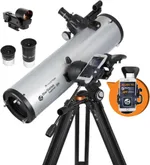
StarSense LT 114AZ specs
| Brand | Celestron |
|---|---|
| Type | Phone-guided (eyepiece) |
| Aperture | 114 mm |
| Focal length / ratio | 1000 mm, f/8.8 |
| Optics | 114 mm Newtonian reflector (1,000 mm in a short tube), manual alt-az |
| Sensor | None (you look through the eyepiece; your phone only navigates) |
| True field (widest eyepiece) | 1.3° × 1.3°. Estimated true field with the 25 mm eyepiece (40×) assuming a ~52° apparent field; Amazon lists 2.04°. |
| Mount | Manual alt-az. Manual alt-az; no tracking |
| Battery | No battery needed |
| Weight | 10.4 lb (4.71 kg). 10.4 lb complete (tube 6.6 lb, tripod 3.8 lb) |
| Filters | None |
| Solar | Optional solar filter. Requires a correctly sized full-aperture solar filter (not included) |
| Mosaic mode | No |
| Planets | Good |
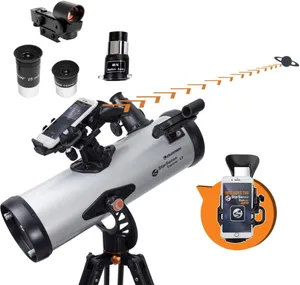
| Eyepiece | 25 mm (40×) and 10 mm (100×) eyepieces plus a 2× Barlow included |
| App | StarSense Explorer app: your phone plate-solves the sky and arrows guide you to targets |
| Subscription | None |
| Warranty | 2 years |
| Price | About $240 on Amazon (Nov 12, 2026) · $ Budget |
- Different category: a manual telescope with a phone-guided finder, not an imaging smart telescope.
- Celestron's spec sheet gives f/9 (8.8 calculated) and limiting magnitude 12.8.
Specs are compiled from manufacturer pages, Amazon listings and independent reviews, and may change with firmware or production runs. Confirm what's in the box (tripod, solar filter, case) on the Amazon page before buying.
Celestron StarSense Explorer LT 114AZ video review

Video by LearnToStargaze on YouTube. Independent creator content, shown as a reference. It is not part of our scoring.
The Celestron StarSense Explorer LT 114AZ is not a smart telescope. It’s a traditional, manually pushed 114 mm reflector with Celestron’s phone-guided finder: your phone sits in a dock, reads the sky and shows arrows to each target, and you look through an eyepiece. We include it as the cheapest sensible alternative for people who mainly want to see the Moon and planets. It costs about $239.99 on Amazon (Nov 12, 2026), sold by Amazon, so check today’s price. We haven’t tested it ourselves; this review summarizes Digital Camera World, Space.com and Celestron’s spec sheet.
Who it’s for (and who should skip it)
It’s for tight budgets and curious beginners: a first telescope to answer “do I actually like this hobby?” for well under the price of any smart scope. At 10.4 lb complete, it.s easy to carry outside and set up quickly.
Skip it if you want pictures. It has no tracking, no stacking and no camera, and faint galaxies and nebulae are dim smudges by eye. A Seestar S30 Plus (about $474) or Dwarf Mini (about $419) will photograph nebulae this scope can barely show. Skip it too if you can stretch your budget: reviewers were noticeably happier with its bigger sibling.
Viewing in practice
Both Space.com and Digital Camera World rated it 3 out of 5. Space.com found Saturn looked good with the included Barlow, but M31 was faint and the Hercules Cluster (M13) was “a faint fuzzy blob”. Digital Camera World saw a “thick purple line” around Jupiter and found the tripod flimsy.
Celestron’s spec sheet gives 114 mm of aperture, 1,000 mm focal length in a short tube (f/9, 8.8 calculated) and limiting magnitude 12.8. That long focal length is why planets reach useful magnification with the supplied eyepieces: 40× and 100×, or 80× and 200× with the 2× Barlow. A wobbly tripod and color fringing are the price of the low cost, so expect bright, small Saturn and Jupiter views rather than fine detail.
App and workflow
The free StarSense Explorer app is the reason to choose this over a plain beginner reflector. Your phone docks above the tube, its camera looks at the sky via a mirror, and the app plate-solves the stars to work out where you’re pointing. Arrows guide you until the target is centered in the eyepiece. There’s no subscription.
After that it’s all manual. The alt-az mount has no motors, so you nudge the tube as Earth’s rotation carries the target across the view, more often at 200× than at 40×. There’s nothing to charge except your phone. Celestron lists a 2-year warranty.
What you’ll need beyond the box
- Dew control. On damp nights the finder and eyepieces fog first. A SVBONY USB dew heater strip clears them.
- A red light. A red LED flashlight for swapping eyepieces in the dark.
- Solar safety. Solar viewing needs a correctly sized full-aperture solar filter over the front of the tube, which isn’t included; measure the tube before buying one. For naked-eye viewing only, keep ISO 12312-2 eclipse glasses handy, and never use them at the eyepiece.
- Phone power. The app runs on your phone, so a UGREEN 20,000 mAh power bank helps on cold nights.
Browse the full accessories page for more.
How it compares
The StarSense Explorer DX 130AZ costs about $500, has a bigger 130 mm mirror and earned 4 out of 5 from both Space.com and BBC Sky at Night. If your budget can reach it, it’s the better traditional scope. Smart telescopes take the opposite approach: small optics, automatic tracking and stacked photos. Our best smart telescope for planets guide and are smart telescopes worth it? explain which approach fits which goal. If you’re still undecided, the telescope matcher asks a few questions and suggests a model.
Bottom line
The LT 114AZ is a cheap, light, phone-guided way to see Saturn’s rings and the Moon in sharp detail. Reviewers flag a flimsy tripod and color fringing, and deep-sky objects are faint by eye. For planets on a small budget it works; for pictures, save for a smart scope. Check the price on Amazon.
Accessories for the StarSense LT 114AZ
Official and compatible add-ons sold on Amazon: filters, solar filters, tripods and wedges, power banks, dew control and cases. Check the listing confirms your exact model before you buy.
- SolarCelestron EclipSmart universal solar filter (75–100 mm)Universal fit
Adjustable ISO 12312-2 compliant film filter for objectives with an outside diameter of 75–100 mm, such as spotting scopes and some traditional telescopes. Too big for 30–50 mm smart scopes; use the maker's own solar filter on those.
- SolarThousand Oaks black-polymer solar filter sheet, 4 × 4 inUniversal fit
DIY solar film for making a secure full-aperture filter cell for a small scope or camera lens. Only for confident DIYers: the cell must fit tightly over the front so it can't blow off. Never use a filter at the eyepiece end.
- SolarSoluna ISO 12312-2 solar eclipse glasses (2-pack)Universal fit
For looking at the Sun with your own eyes while the scope images it; never look through a telescope with them.
- PowerAnker 737 power bank, 24,000 mAh, 140 WUniversal fit
USB-C PD power bank big enough to run a 30–50 mm smart scope through a long winter night, when cold cuts battery life. Check your scope's manual for supported USB-C input while observing; Unistellar, Vaonis and Celestron Origin use their own batteries and chargers.
- PowerUGREEN Nexode 100 W power bank, 20,000 mAhUniversal fit
Cheaper USB-C PD bank that also tops up your phone, which runs the telescope's app all night.
- Dew controlSVBONY SV172 USB dew heater strip, 320 mmCompatible, third-party
Three-level USB heater strip for finders, eyepieces and camera lenses on humid nights. Only for traditional optics or camera lenses; most smart scopes have their own anti-dew heating, and strapping a heater over their housings can block sensors or vents.
- ObservingCelestron Night Vision red LED flashlightUniversal fit
Dimmable red light keeps your dark adaptation for finding cables, levels and the tripod at night.
Compatibility checked November 2026. More in our smart telescope accessories guide.
Featured in our guides
- Best Smart Telescope for Kids (2026): 5 Family-Friendly Picks and the Solar Safety Rule
- Best Budget Smart Telescopes (2026): 4 Picks Under $700, Plus the Hidden Costs
- Smart Telescope Gift Guide 2026: The Best Picks at Every Budget, Plus Stocking Stuffers
- Smart Telescope vs Traditional Telescope: Which Should You Buy?