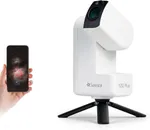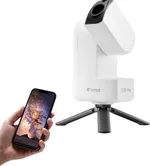
Dwarf Mini specs
| Brand | DWARFLAB |
|---|---|
| Type | Smart telescope |
| Aperture | 30 mm |
| Focal length / ratio | 150 mm, f/5 |
| Optics | 6-element apochromatic lens group |
| Sensor | Sony IMX662 (1/2.8-inch) |
| Resolution | 1920 × 1080 px (2.1 MP) |
| Pixel size / scale | 2.9 µm · 3.99″ per pixel |
| Field of view | 2.13° × 1.2°. Computed from 1920 × 1080 × 2.9 µm and 150 mm; DWARFLAB quotes 2.45° (diagonal). |
| Wide-angle camera | OmniVision OS02K10 wide-angle camera, 1080p, about 50.6° diagonal |
| Mount | Motorized alt-az + EQ mode. EQ mode on a tilting tripod head; manually aligned on Polaris with app guidance; tripod not included |
| Battery | 7,000 mAh (3.85 V); about 4 h (maker); USB-C input and external USB power supported |
| Weight | 1.9 lb (0.84 kg). 100 × 184 × 61 mm |
| Storage | 64 GB |
| Filters | Astro (440–680 nm), dark and dual narrowband (OIII / H-alpha) filters |
| Solar | Solar filter included. Magnetic ND filter for solar imaging in the box |
| Mosaic mode | Yes. Astro mosaic mode (maximum size not stated) |
| Planets | Basic (small discs) |
| Eyepiece | No (view on phone or tablet) |
| App | DWARFLAB app with Stellar Studio processing |
| Subscription | None for core features |
| Warranty | 2 years |
| Price | About $419 on Amazon (Nov 12, 2026) · $ Budget |
- The Digital Camera World, Live Science and Space.com reviews were all written by the same reviewer (Jamie Carter), so treat them as one opinion. BBC Sky at Night rated it 5 out of 5.
- Digital Camera World lists the field as 2.45 × 2.14°, which appears to mix the diagonal with the width; our figure is computed from the sensor.
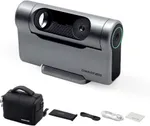
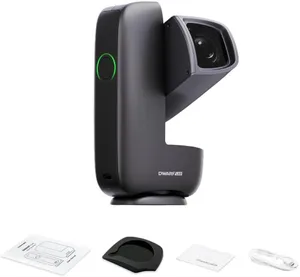
Specs are compiled from manufacturer pages, Amazon listings and independent reviews, and may change with firmware or production runs. Confirm what's in the box (tripod, solar filter, case) on the Amazon page before buying.
DWARFLAB Dwarf Mini Smart Telescope video review

Video by AstroBackyard on YouTube. Independent creator content, shown as a reference. It is not part of our scoring.
The Dwarf Mini is DWARFLAB’s pocket-sized smart telescope: a 30 mm f/5 lens with six apochromatic elements, a 2 MP Sony IMX662 sensor, built-in dual narrowband, astro and dark filters, and a magnetic solar filter, in a body that weighs 840 g. It costs about $419 on Amazon (Nov 12, 2026); check today’s price. We haven’t tested it ourselves. Note that the Digital Camera World, Live Science and Space.com reviews were all written by the same reviewer (Jamie Carter), so we treat them as one opinion; BBC Sky at Night separately rated it 5 out of 5. More on our approach in how we research.
Who the Dwarf Mini is for (and who should skip it)
It’s for hikers, travelers and budget buyers who want the smallest, lightest smart telescope available: something that fits a jacket pocket and handles the Moon, the Sun, bright nebulae and daytime wildlife.
Skip it if resolution matters. The 1920 × 1080 sensor is the lowest of any smart scope we cover, and the Seestar S30 Pro and Dwarf 3 both resolve more. Skip it too if you’d rather not buy extras: there’s no tripod or case in the box.
Imaging in practice
Live Science rated the Mini’s solar and lunar imaging excellent, and called its planetary results disappointing. That fits the numbers. At about 4 arcseconds per pixel, Jupiter is roughly 11 pixels across, so the planets are small discs at best.
Space.com’s review was shot from a Bortle 8 city, which is a realistic test of the built-in dual narrowband filter on emission nebulae. Digital Camera World flagged the low 2 MP resolution as a con.
The field is about 2.13° × 1.2° (computed from the sensor; DWARFLAB quotes 2.45° diagonal). The Andromeda Galaxy needs two panels, and the Mini has an astro mosaic mode, though DWARFLAB doesn’t state its maximum size. Try your targets in the FOV calculator and check what’s realistic from your sky with the sky target checker.
DWARFLAB claims exposures up to 90 seconds in EQ mode, where you tilt the scope on a tripod head and align it on Polaris with the app’s guidance.
App and workflow
The Mini runs on the DWARFLAB app, with no subscription for core features. Processing happens in DWARFLAB’s Stellar Studio, which Digital Camera World found slow. Storage is 64 GB.
Battery life is the main practical limit. DWARFLAB quotes about four hours from the 7,000 mAh pack, and Space.com’s reviewer got about the same. The Mini accepts USB-C and external USB power, so a power bank is the easy fix.
What you’ll need beyond the box
- A tripod. The DWARFLAB mini tripod with hydraulic head (about $89, rated for 3 kg) is the simple choice and makes EQ mode easy. Our EQ mode explainer covers the setup.
- A case. The USA Gear carrying case has room for the scope, a mini tripod and a power bank.
- Power. A USB-C bank such as the UGREEN Nexode 20,000 mAh or the larger Anker 737 doubles your observing time.
- Solar. The ND solar filter is included; ISO 12312-2 eclipse glasses are for your own eyes. Our guide to photographing the Sun covers safe setup.
- A red flashlight, such as the Celestron Night Vision.
How it compares
The Seestar S30 Plus costs about $474 with a tripod, case and solar filter included, and its 2K sensor resolves more, but it weighs twice as much. The Dwarf 3 is the bigger sibling at about $549: 4K, 35 mm, a longer battery and an IP54 body, at 1.35 kg. The Seestar S30 Pro is the travel benchmark with a much wider field.
Our best smart telescopes for travel and best budget smart telescopes guides put all of these side by side.
Bottom line
The Dwarf Mini is the lightest way into smart-telescope imaging, with good filters and a solar filter for about $419. Budget another $89 for a tripod, carry a power bank, and accept 2 MP images. If weight is your deciding factor, it’s the pick. Check the Dwarf Mini price on Amazon.
See what the Dwarf Mini can capture from your sky in the sky target checker, or frame any target in the field-of-view calculator.
Accessories for the Dwarf Mini
Official and compatible add-ons sold on Amazon: filters, solar filters, tripods and wedges, power banks, dew control and cases. Check the listing confirms your exact model before you buy.
- Tripod & wedgeDWARFLAB mini tripod with hydraulic headOfficial DWARFLAB
Compact 1/4-inch tripod with a tilting hydraulic head, the simple way to set the Dwarf 3 or Dwarf Mini up for EQ mode. Rated for 3 kg (6.6 lb).
- SolarCelestron EclipSmart universal solar filter (75–100 mm)Universal fit
Adjustable ISO 12312-2 compliant film filter for objectives with an outside diameter of 75–100 mm, such as spotting scopes and some traditional telescopes. Too big for 30–50 mm smart scopes; use the maker's own solar filter on those.
- SolarThousand Oaks black-polymer solar filter sheet, 4 × 4 inUniversal fit
DIY solar film for making a secure full-aperture filter cell for a small scope or camera lens. Only for confident DIYers: the cell must fit tightly over the front so it can't blow off. Never use a filter at the eyepiece end.
- SolarSoluna ISO 12312-2 solar eclipse glasses (2-pack)Universal fit
For looking at the Sun with your own eyes while the scope images it; never look through a telescope with them.
- PowerAnker 737 power bank, 24,000 mAh, 140 WUniversal fit
USB-C PD power bank big enough to run a 30–50 mm smart scope through a long winter night, when cold cuts battery life. Check your scope's manual for supported USB-C input while observing; Unistellar, Vaonis and Celestron Origin use their own batteries and chargers.
- PowerUGREEN Nexode 100 W power bank, 20,000 mAhUniversal fit
Cheaper USB-C PD bank that also tops up your phone, which runs the telescope's app all night.
- CaseUSA Gear carrying case for Dwarf Mini and Dwarf 3Compatible, third-party
Padded shoulder case with dividers for the telescope, a mini tripod and power bank.
- ObservingCelestron Night Vision red LED flashlightUniversal fit
Dimmable red light keeps your dark adaptation for finding cables, levels and the tripod at night.
Compatibility checked November 2026. More in our smart telescope accessories guide.
Featured in our guides
- Best Smart Telescope for Kids (2026): 5 Family-Friendly Picks and the Solar Safety Rule
- Best Budget Smart Telescopes (2026): 4 Picks Under $700, Plus the Hidden Costs
- Best Smart Telescope for Travel (2026): Light, Long-Running Picks for Flights and Dark Skies
- Smart Telescope Gift Guide 2026: The Best Picks at Every Budget, Plus Stocking Stuffers