Best Smart Telescope for Travel (2026): Light, Long-Running Picks for Flights and Dark Skies
Our top picks
 Best for travel: 1.65 kg, 4K sensor, Milky Way panoramas, tripod and solar filter included, about $664ZWO Seestar S30 Pro Smart Telescope30 mm f/5.3 · 3.99° × 2.24° · 3.6 lb8.5Price tier: Mid-rangeCheck price on Amazon
 Lightest: 840 g and pocket-sized, tripod extra, about $419DWARFLAB Dwarf Mini Smart Telescope30 mm f/5 · 2.13° × 1.2° · 1.9 lb7.8Price tier: BudgetCheck price
 Best travel all-rounder: 1.35 kg, IP54, wildlife mode by day, about $549DWARFLAB Dwarf 3 Smart Telescope35 mm f/4.3 · 2.93° × 1.65° · 3 lb8.2Price tier: BudgetCheck price
 Best budget travel kit: case and tripod in the box, about $474ZWO Seestar S30 Plus Smart Telescope30 mm f/5.3 · 2.66° × 1.5° · 3.6 lb8.2Price tier: BudgetCheck price
 Best if you drive: 50 mm, up to 9 h battery, hard case included, about $999ZWO Seestar S50 Pro Smart Telescope50 mm f/5.2 · 2.45° × 1.38° · 6.2 lb8.6Price tier: Mid-rangeCheck price
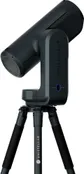 Best big-aperture traveler: 85 mm with a cabin-size backpack option, about $2,079Unistellar Odyssey Smart Telescope85 mm f/3.9 · 0.75° × 0.56° · 8.8 lb7.6Price tier: PremiumCheck price
The best reason to travel with a smart telescope is the sky at the other end. Under a dark site even a 30 mm scope pulls faint nebulae out of the background far faster than from a suburb, and a 63° wide camera can stitch the Milky Way from a desert or a mountain cabin. The best travel scope is the one light enough that you actually pack it, with a battery that survives a cold night away from outlets.
We haven’t tested these ourselves. This guide uses maker specs, Amazon prices checked on November 12, 2026 (check today’s price before you buy), and independent reviews, each named where it’s used.
Travel specs at a glance
| Telescope | Weight (scope) | Battery (maker) | Storage | Tripod in box | Price |
|---|---|---|---|---|---|
| Dwarf Mini | 840 g | ~4 h | 64 GB | No | ~$419 |
| Dwarf 3 | 1.35 kg | 5.5 h | 128 GB | No | ~$549 |
| Seestar S30 Pro | 1.65 kg | ~6 h | 128 GB | Mini tripod | ~$664 |
| Seestar S30 Plus | 1.65 kg | 6 h | 64 GB | Mini tripod | ~$474 |
| Seestar S50 Pro | 2.8 kg | 9 h | 128 GB | Carbon tripod | ~$999 |
| Unistellar Odyssey | 4 kg | 5 h | 64 GB | Yes (5.5 lb) | ~$2,079 |
For scale, the Dwarf Mini measures 100 × 184 × 61 mm, the Dwarf 3 222 × 142 × 65 mm and the S30 Plus 210 × 140 × 80 mm.
1. Seestar S30 Pro: Best for travel
The Seestar S30 Pro is the scope we’d pack. At 1.65 kg it slips into a daypack, and it brings the most capability per kilogram here: a 4K Sony IMX585 behind a 30 mm four-element ED apochromat, a 4K, 63° wide camera that stitches 8K Milky Way panoramas, a built-in duo-band filter, an anti-dew heater and a solar filter. Space.com’s 2026 roundup names it best for portability.
Its 4° × 2.2° field is the widest here, which is exactly what dark-sky trips reward: big nebulae and the whole Andromeda Galaxy in one frame. The trade-offs are a 30 mm aperture and full reliance on your phone (Digital Camera World flags frequent data downloads). Add a CASEMATIX hard case (about $29) for luggage. Check the S30 Pro price, or weigh it against the bigger Seestar in S30 Pro vs S50 Pro.
2. Dwarf Mini: Lightest
The Dwarf Mini is the smallest, lightest smart telescope we cover at 840 g, small enough for a jacket pocket. DWARFLAB includes astro, dark and dual narrowband filters and a magnetic solar filter, and claims EQ mode. BBC Sky at Night rated it 5 out of 5, and Space.com used it from a Bortle 8 city.
The weaknesses show up on longer trips: about four hours of battery, a 2 MP sensor and no tripod or case. DWARFLAB supports external USB power, so a power bank fixes the first. Add the DWARFLAB mini tripod (about $89) and a USA Gear case (about $40). Check the Dwarf Mini price.
3. Dwarf 3: Best travel all-rounder
The Dwarf 3 earns its place on trips because it works in daylight too. It tracks wildlife and shoots landscapes, then switches to deep-sky imaging at night with a 4K Starvis 2 sensor and a dual narrowband filter. At 1.35 kg with an IP54 rating, it’s built for the outdoors.
It’s also the best-documented cold-weather performer: BBC Sky at Night got over four hours from a charge in near-zero temperatures, against DWARFLAB’s 5.5-hour room-temperature figure. Like the Mini, it needs a tripod. About $549; check the Dwarf 3 price. See Dwarf 3 vs Seestar S30 Pro for the head-to-head.
4. Seestar S30 Plus: Best budget travel kit
The Seestar S30 Plus has the same 1.65 kg body and 30 mm lens as the S30 Pro, and its box already contains what a traveler needs: a protective case, a mini tripod and a magnetic solar filter. It drops to a 2K sensor and loses Milky Way panoramas, which matters more on a dark-sky trip than in a backyard.
Watch storage on long trips: 64 GB, about 45 GB usable, so offload to your phone or laptop each night. About $474; check the S30 Plus price.
5. Seestar S50 Pro: Best if you drive
The Seestar S50 Pro is heavier at 2.8 kg (Live Science weighed 2.7 kg), but it comes with a hard case and carbon tripod and has the longest battery of the small scopes: up to 9 hours by ZWO’s figure, measured above 25 °C. AstroBackyard notes it drops in the cold, so plan on less on a winter trip. Live Science found the included tripod very short.
If your travel means a car trunk and a campsite, its 50 mm aperture is the better imager. About $999; check the S50 Pro price.
6. Unistellar Odyssey: Best big-aperture traveler
The Unistellar Odyssey is the most aperture you can realistically fly with: 85 mm, autofocus and no collimation, at 8.8 lb plus a 5.5 lb tripod. Unistellar’s transportation backpack (about $239) is airline cabin-size at 55 × 38.5 × 16 cm and holds the scope and tripod in foam.
Two travel warnings. Digital Camera World found the battery only recharges with the supplied adapter cable, so don’t leave it at home. And the narrow 45′ × 34′ field means the wide Milky Way and nebula vistas that dark sites are famous for won’t fit. About $2,079; check the Odyssey price.
Power and cold-weather batteries
Maker battery figures are best cases. ZWO’s 9-hour S50 Pro figure was measured above 25 °C, and DWARFLAB’s 5.5 hours for the Dwarf 3 at room temperature. Cold nights at altitude cut that, and running an anti-dew heater costs more.
- Bring a USB-C PD power bank. The UGREEN Nexode 20,000 mAh (about $60) or Anker 737 24,000 mAh (about $99) can top up a Seestar or Dwarf and your phone, which runs the app all night. Check your scope’s manual for running on USB power while observing.
- Keep batteries warm until you set up, and charge everything the afternoon before.
- Unistellar is different: it uses its own battery and charging cable, so a power bank won’t help unless you’ve confirmed it works.
| Item | Type | Fits | Buy |
|---|---|---|---|
| Anker 737 power bank, 24,000 mAh, 140 W USB-C PD power bank big enough to run a 30–50 mm smart scope through a long winter night, when cold cuts battery life. | Power | Any telescope (Check your scope's manual for supported USB-C input while observing; Unistellar, Vaonis and Celestron Origin use their own batteries and chargers.) | Check price |
| UGREEN Nexode 100 W power bank, 20,000 mAh Cheaper USB-C PD bank that also tops up your phone, which runs the telescope's app all night. | Power | Any telescope | Check price |
| Vaonis Vespera hygrometer sensor Measures humidity and temperature to trigger the Vespera's built-in demister automatically. | Dew control | Vespera II (Vaonis lists automatic anti-fog as built in on the Vespera 3 and Pro 2, so this is mainly an upgrade for the Vespera II.) | Check price |
| Neo3D Shop dew shield and lens cover kit for Seestar S30 / S30 Pro PETG dew shield and dust cap that slow dew forming on the S30-series front glass and keep stray light out. | Dew control | Seestar S30 Plus, Seestar S30 Pro (Listed for the S30 and S30 Pro; we couldn't confirm the S30 Plus shares the same front housing.) | Check price |
| SVBONY SV172 USB dew heater strip, 320 mm Three-level USB heater strip for finders, eyepieces and camera lenses on humid nights. | Dew control | StarSense DX 130AZ, StarSense LT 114AZ (Only for traditional optics or camera lenses; most smart scopes have their own anti-dew heating, and strapping a heater over their housings can block sensors or vents.) | Check price |
| MASK PRO system starter kit for Dwarf 3 Magnetic dew shield plus Bahtinov and diffraction-spike masks made for the Dwarf 3. | Dew control | Dwarf 3 (Not compatible with the Dwarf II per the listing.) | Check price |
| Unistellar transportation backpack for Odyssey and Odyssey Pro Airline cabin-size backpack (55 × 38.5 × 16 cm) with foam that holds the Odyssey and its tripod. | Case | Unistellar Odyssey, Odyssey Pro | Check price |
| Unistellar transportation backpack for eVscope 2 and eQuinox 2 Form-fitted backpack with internal straps and a rain cover for Unistellar's 114 mm scopes. | Case | eVscope 2, eQuinox 2 | Check price |
| CASEMATIX hard-shell carry case for Seestar S30 Pro Foam-lined hard case with an accessory pouch for travel and car trips. | Case | Seestar S30 Plus, Seestar S30 Pro (Sold for the S30 Pro; the S30 Plus has the same listed dimensions on Amazon, but confirm before buying.) | Check price |
| USA Gear carrying case for Dwarf Mini and Dwarf 3 Padded shoulder case with dividers for the telescope, a mini tripod and power bank. | Case | Dwarf 3, Dwarf Mini | Check price |
| Celestron Night Vision red LED flashlight Dimmable red light keeps your dark adaptation for finding cables, levels and the tripod at night. | Observing | Any telescope | Check price |
Flying with a smart telescope
The 30–35 mm scopes are small enough for an ordinary cabin bag, and Unistellar’s backpack is cabin-size for the Odyssey. Pack the telescope in a padded case inside your carry-on rather than checked luggage. Smart telescopes and power banks contain lithium batteries, and airlines set their own rules for those, so check your carrier’s battery policy before you fly. Bring the scope’s own charging cable and a spare USB-C cable.
When you arrive, the sky target checker shows what’s up for your scope under darker skies, and the stacking time estimator suggests how long to give a target.
How we chose
We weighted portability and build more heavily than in our main ranking: weight, size, what’s in the box for travel, battery life (maker and measured), cold-weather reports and charging flexibility. Image quality still counts, which is why the S30 Pro beats the lighter Dwarf Mini. Scopes of 5 kg or more, such as the Vesperas, the eQuinox 2 and the 41.6 lb Origin Mark II, didn’t qualify. The full method is on how we research. Buying for a traveler? See our smart telescope gift guide.
Frequently asked questions
What is the best smart telescope for travel?
What is the lightest smart telescope?
Can I take a smart telescope on a plane?
How long do smart telescope batteries last in the cold?
Do I need a tripod for a travel smart telescope?
Sources
- Space.com: The best smart telescopes · checked 2026-11-12 — Names the Seestar S30 Pro its pick for portability (roundup updated Nov 4, 2026).
- BBC Sky at Night: DWARFLAB Dwarf 3 review · checked 2026-11-12 — Got over four hours from a charge in near-zero temperatures.
- AstroBackyard: Seestar S50 Pro review · checked 2026-11-12 — Notes the S50 Pro's battery life drops in cold weather and that the battery carries a 1-year warranty.
- Digital Camera World: Unistellar Odyssey review · checked 2026-11-12 — Found the Odyssey's battery only recharges with the supplied adapter cable.
- Space.com: DWARFLAB Dwarf Mini review · checked 2026-11-12 — Got about 4 hours of battery and imaged from a Bortle 8 city.
Get new guides by e-mail
One short e-mail when Smart Telescope Review publishes a new guide. No spam, no sharing your address, and you can unsubscribe in one click.