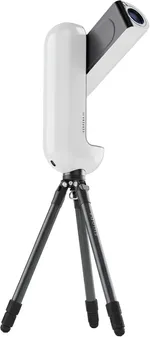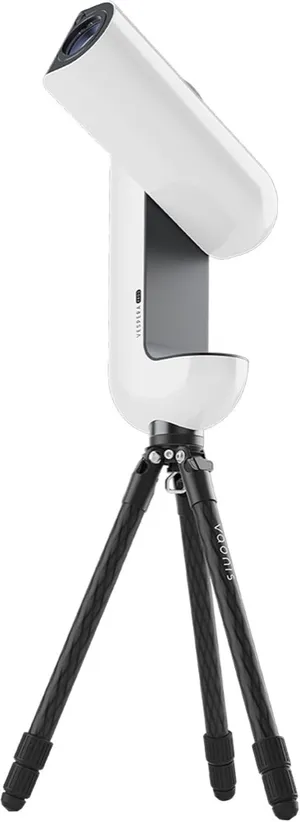
Vespera Pro 2 specs
| Brand | Vaonis |
|---|---|
| Type | Smart telescope |
| Aperture | 50 mm |
| Focal length / ratio | 245 mm, f/4.9 |
| Optics | Flat-field apochromatic quadruplet (Petzval-inspired, ULD glass) with stray-light baffles |
| Sensor | Sony IMX676 (1/1.6-inch, square) |
| Resolution | 3536 × 3536 px (12.5 MP) |
| Pixel size / scale | 2 µm · 1.68″ per pixel |
| Field of view | 1.6° × 1.6°. Vaonis figure (about 1.7″ per pixel). |
| Mount | Motorized alt-az. No EQ mode |
| Battery | 11 h (Vaonis) |
| Weight | 11 lb (5 kg). IP43; carbon tripod and fly case included |
| Storage | 225 GB |
| Filters | None built in; light-pollution, dual-band and solar filters sold separately; automatic anti-fog |
| Solar | Optional solar filter. Vaonis sells a solar filter separately |
| Mosaic mode | Yes. CovalENS mosaics up to 50 MP (3.2° × 3.2° per Vaonis' launch page) |
| Planets | Not recommended by maker |
| Eyepiece | No (view on phone or tablet) |
| App | Singularity (iOS/Android) with full manual control |
| Subscription | No subscription found on Vaonis' site |
| Warranty | 5 years |
| Price | About $2,990 on Amazon (Nov 12, 2026) · $$$ Premium |
- Vaonis' pages disagree on pixel scale (1.6″ vs 1.7″) and maximum mosaic (3.2° × 3.2° vs 4.18° × 2.45°); 2.0 µm at 245 mm works out to about 1.68″.
- ScopeTrader's launch coverage quotes Strehl ratios supplied by Vaonis; we treat those as maker claims.
- The original Vespera Pro is marked as a legacy, discontinued model on Vaonis' comparison page.
Specs are compiled from manufacturer pages, Amazon listings and independent reviews, and may change with firmware or production runs. Confirm what's in the box (tripod, solar filter, case) on the Amazon page before buying.
Vaonis Vespera Pro 2 Smart Telescope video review

Video by The Space Koala on YouTube. Independent creator content, shown as a reference. It is not part of our scoring.
The Vespera Pro 2 is Vaonis’ high-resolution 50 mm smart telescope, launched April 11, 2026 alongside the Vespera 3 and replacing the discontinued Vespera Pro. It uses the same flat-field apochromatic quadruplet (245 mm, f/4.9) as the Vespera 3, but with a 12.5 MP square Sony IMX676 sensor, automatic master darks, manual control, an 11-hour battery, a carbon tripod, a hard case and a five-year warranty. It costs about $2,990 on Amazon (Nov 12, 2026); check today’s price. We haven’t tested it ourselves, and we found no independent written review yet, so much of what follows is Vaonis’ own claims, labeled as such. Our method is on the how we research page.
Who the Vespera Pro 2 is for (and who should skip it)
It’s for detail-hungry imagers who want the finest sampling of any 50 mm smart telescope, plus the controls and calibration that make the raw data worth processing: manual exposure, automatic darks and FITS export.
Skip it if you’re new to the hobby or watching your budget. The Seestar S50 Pro gets most of the way for about a third of the price, with a built-in dual-band filter and EQ mode. Skip it too if you mainly shoot large nebulae: the square 1.6° field is the smallest in the Vespera range.
Imaging in practice
With no independent written review, there are no outside test results to report yet. Here’s what the specs and launch coverage say.
The IMX676 has 2.0 µm pixels, which at 245 mm works out to about 1.68 arcseconds per pixel (Vaonis quotes both 1.6″ and 1.7″). That’s noticeably finer than the roughly 2.4″ of the Vespera 3 and Vespera II, so small galaxies and planetary nebulae carry more pixels. Jupiter comes out about 27 pixels across: a small disc with belts, not a planetary close-up.
ScopeTrader’s launch article quotes Vaonis-supplied Strehl ratios of about 0.87 for the new optics versus 0.54 for the Vespera II. That’s a meaningful claim, but it’s the maker’s figure, not an independent measurement.
The trade-off is field. At 1.6° × 1.6°, the Orion Nebula just fits one frame, while the Andromeda Galaxy needs about three panels. CovalENS mosaics reach 50 MP (Vaonis’ pages give 3.2° × 3.2° or 4.18° × 2.45°). Plan framing in the FOV calculator and check your sky with the sky target checker.
App and workflow
The Pro 2 runs on Singularity, Vaonis’ app, with no subscription we could find on Vaonis’ site, and adds full manual control: exposure from 1 to 30 seconds and adjustable gain. Vaonis says it builds master darks automatically and applies BalENS gradient removal, which addresses the hot-pixel complaint Zelpio raised about the Vespera 3.
Multi-night projects resume automatically, and 225 GB of usable storage plus the 11-hour battery (both Vaonis figures) leave room for long mosaics.
For a look at the scope in use, The Space Koala’s video is embedded on this page; Galactic Hunter also posted a first look in April 2026.
What you’ll need beyond the box
- A dual-band filter for suburban skies. The Vaonis Dual Band filter is the obvious upgrade for emission nebulae, but it’s sold for “Vespera” and Vaonis’ Pro 2 listings don’t confirm this exact part. Check Vaonis’ compatibility list before ordering. The same applies to the broadband Vaonis CLS filter. Our filter guide explains which targets each one helps.
- Solar. Vaonis sells a solar filter separately. ISO 12312-2 eclipse glasses are for your eyes only.
- A red flashlight, such as the Celestron Night Vision.
The tripod, case, battery and anti-fog are already covered.
How it compares
Wider fields fit big nebulae and Andromeda; narrower fields put more pixels on small galaxies. Try any target in the framing calculator.
The Vaonis Vespera 3 shares the optics, battery and warranty for about $2,490, with a wider field but no automatic darks or manual control. The Seestar S50 Pro is the value alternative at about $999. If small galaxies are the goal, the Unistellar eQuinox 2 brings 114 mm of aperture for about $2,319, with a narrow field and no mosaic mode.
Our Seestar vs Vespera vs Unistellar comparison and best smart telescopes guide put it in context.
Bottom line
The Vespera Pro 2 is the 50 mm smart telescope for people who zoom in and want to process their own data: fine sampling, automatic darks, manual control and an all-night battery, with a tripod, case and five-year warranty included. It’s an enthusiast buy with no independent written review yet, so weigh that against the price. Check the Vespera Pro 2 price on Amazon.
See what the Vespera Pro 2 can capture from your sky in the sky target checker, or frame any target in the field-of-view calculator.
Accessories for the Vespera Pro 2
Official and compatible add-ons sold on Amazon: filters, solar filters, tripods and wedges, power banks, dew control and cases. Check the listing confirms your exact model before you buy.
- FilterVaonis Vespera Dual Band filter (AC022)Official Vaonis
H-alpha + OIII dual narrowband filter that the Vespera detects automatically, for nebulae from light-polluted skies. Sold for 'Vespera'; Vaonis' newer Vespera 3 and Pro 2 listings don't confirm this exact part. Check the maker's compatibility list before ordering.
- FilterVaonis Light Pollution (CLS) filter for VesperaOfficial Vaonis
Broadband light-pollution filter that threads onto the Vespera (78 mm thread) to cut sodium and mercury-vapor glow while keeping star color. Broadband filters help far less with modern white LED light pollution than dual-band filters do.
- SolarCelestron EclipSmart universal solar filter (75–100 mm)Universal fit
Adjustable ISO 12312-2 compliant film filter for objectives with an outside diameter of 75–100 mm, such as spotting scopes and some traditional telescopes. Too big for 30–50 mm smart scopes; use the maker's own solar filter on those.
- SolarThousand Oaks black-polymer solar filter sheet, 4 × 4 inUniversal fit
DIY solar film for making a secure full-aperture filter cell for a small scope or camera lens. Only for confident DIYers: the cell must fit tightly over the front so it can't blow off. Never use a filter at the eyepiece end.
- SolarSoluna ISO 12312-2 solar eclipse glasses (2-pack)Universal fit
For looking at the Sun with your own eyes while the scope images it; never look through a telescope with them.
- PowerAnker 737 power bank, 24,000 mAh, 140 WUniversal fit
USB-C PD power bank big enough to run a 30–50 mm smart scope through a long winter night, when cold cuts battery life. Check your scope's manual for supported USB-C input while observing; Unistellar, Vaonis and Celestron Origin use their own batteries and chargers.
- PowerUGREEN Nexode 100 W power bank, 20,000 mAhUniversal fit
Cheaper USB-C PD bank that also tops up your phone, which runs the telescope's app all night.
- ObservingCelestron Night Vision red LED flashlightUniversal fit
Dimmable red light keeps your dark adaptation for finding cables, levels and the tripod at night.
Compatibility checked November 2026. More in our smart telescope accessories guide.
Featured in our guides
- Seestar vs Vespera vs Unistellar: Which Smart Telescope Brand Fits You?
- How Smart Telescopes Work: Plate Solving, Live Stacking and the Numbers That Matter