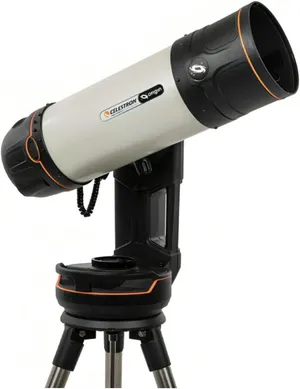
Origin Mark II specs
| Brand | Celestron |
|---|---|
| Type | Smart telescope |
| Aperture | 152 mm |
| Focal length / ratio | 335 mm, f/2.2 |
| Optics | 6-inch Rowe-Ackermann Schmidt Astrograph (RASA), autofocus, dew heater |
| Sensor | Sony IMX678 Starvis 2 (Origin 678C camera) |
| Resolution | 3856 × 2180 px (8.4 MP) |
| Pixel size / scale | 2 µm · 1.23″ per pixel |
| Field of view | 1.32° × 0.75°. Figure from Space.com and Astronomy.com (about 1.2″ per pixel). |
| Mount | Motorized alt-az. Optional Celestron equatorial wedge (supported in the app) |
| Battery | 97.9 Wh LiFePO4 (Celestron); '6+ hours' per Space.com, but BBC Sky at Night measured about 3 h near 0 °C |
| Weight | 41.6 lb (18.87 kg). 41.6 lb complete (Space.com): tube, mount and tripod |
| Filters | Filter drawer for 1.25-inch and 2-inch filters; Celestron Nebula filter sold separately |
| Solar | Celestron doesn't offer solar imaging for the RASA-based Origin; never point it at the Sun |
| Mosaic mode | Yes. Mosaic capture added in a free app update (v1.2.1, October 2026) |
| Planets | Basic (small discs) |
| Eyepiece | No (view on phone or tablet) |
| App | Celestron Origin app, powered by SkySafari (iOS/Android) |
| Subscription | None found: the app is free with no in-app purchases listed |
| Warranty | Amazon lists a 1-year limited warranty; we couldn't confirm it on Celestron's site |
| Price | About $4,299 on Amazon (Nov 12, 2026) · $$$$ Flagship |
- The original Origin (Sony IMX178, 6.4 MP) launched at $3,999 in 2024; its Amazon listing had no buy box on Nov 12, 2026.
- Sources give 8.3 MP or 8.4 MP for the IMX678; the 3856 × 2180 grid is about 8.4 MP.
- There is no 'Origin Mini': we found no evidence of such a model.
- The Amazon listing on Nov 12, 2026 was sold by Adorama.
Specs are compiled from manufacturer pages, Amazon listings and independent reviews, and may change with firmware or production runs. Confirm what's in the box (tripod, solar filter, case) on the Amazon page before buying.
Celestron Origin Mark II Intelligent Home Observatory video review

Video by Astro La Vista on YouTube. Independent creator content, shown as a reference. It is not part of our scoring.
The Celestron Origin Mark II is the most capable smart telescope you can buy on Amazon: a 6-inch (152 mm) f/2.2 Rowe-Ackermann Schmidt Astrograph (RASA) with autofocus, a dew heater and a new Sony IMX678 Starvis 2 sensor. It costs about $4,299 on Amazon (Nov 12, 2026), where the listing was sold by Adorama, so check today’s price and seller. We haven’t tested it ourselves; this review draws on BBC Sky at Night, Space.com, Astronomy.com and ScopeTrader.
Who it’s for (and who should skip it)
It’s for backyard imagers with a permanent or semi-permanent setup who want the deepest, fastest smart-telescope images available. Space.com’s 2026 roundup picks it for deep sky.
Skip it if you travel, observe from a balcony or carry gear down stairs. The complete setup weighs 41.6 lb (Space.com). Skip it too if you want solar imaging, which Celestron doesn’t offer for the Origin, or if you’d rather spend under $1,000: a Seestar S50 Pro covers the basics for less than a quarter of the price.
Imaging in practice
Space.com (Brett Tingley) found that 5–10 minute stacks were enough for crisp galaxies, a direct result of 152 mm of aperture at f/2.2. Nothing else here gathers light that quickly. The Mark II’s IMX678 gives about 1.2″ per pixel over a 1.32 × 0.75° field (Space.com and Astronomy.com figures).
BBC Sky at Night (Ivana Peranic) rated it 4.5 out of 5 but noted that the small sensor under-uses the RASA’s 22 mm image circle, so the optics could cover a wider field than the camera records. The magazine also found you can’t pause and resume a session, and measured about 3 hours of battery near 0 °C. Space.com mentions audible motors.
Planets are basic. Our tool math gives Jupiter roughly 37 pixels across: bigger than small smart scopes manage, but a RASA is a wide, fast deep-sky design, not a planetary one. Compare targets in the FOV calculator, estimate exposure with the integration time tool, and check tonight’s sky in the sky target checker.
App and workflow
The Celestron Origin app is powered by SkySafari and is free on iOS and Android; we found no in-app purchases. Celestron has kept improving it: 2026 updates added dithering, and version 1.2.1 (October 19, 2026) added mosaic capture. Astronomy.com covered the mosaic update on Nov 9, 2026. With a field of about 1.32 × 0.75°, the Andromeda Galaxy needs roughly a 3 × 2 grid, so mosaics turn the Origin into a credible wide-field imager.
The single-arm alt-az mount can be tilted for equatorial mode with an optional wedge, which the app supports. Images save to your phone or a USB drive rather than internal storage. A filter drawer takes 1.25-inch and 2-inch filters. Amazon lists a 1-year limited warranty, which we couldn’t confirm on Celestron’s site.
What you’ll need beyond the box
- A narrowband filter. The Celestron Nebula Filter for Origin (H-alpha, H-beta, OIII) is the biggest upgrade for emission nebulae from suburban skies. It does nothing for galaxies or star clusters.
- An equatorial wedge. The Celestron wedge for NexStar SE, Evolution and Origin removes field rotation for longer exposures. The Amazon title lists Origin but the bullet points don’t, so confirm Mark II compatibility with Celestron first. Our EQ mode explainer covers when it’s worth it.
- Phone power. The Origin has its own battery; your phone doesn’t. A UGREEN 20,000 mAh power bank keeps it running.
- A red light. A red LED flashlight for setup in the dark.
No solar accessory belongs on this list: never aim the Origin at the Sun. More on the accessories page.
How it compares
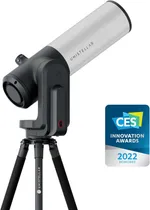
The Vaonis Vespera Pro 2 costs about $2,990, weighs a fraction as much and has a wider 1.6° square field, but only 50 mm of aperture. The Unistellar eQuinox 2 offers 114 mm for about $2,319 with no mosaic mode. Our Celestron Origin vs Seestar comparison weighs the extremes, and smart telescopes in light-polluted cities explains where filters matter.
Bottom line
If you have a backyard, power and patience, the Origin Mark II produces the best images of any smart telescope here, and mosaic mode removes its old narrow-field excuse. It’s also 41.6 lb, $4,299 and strictly a home instrument. If that fits your life, check the price on Amazon.
See what the Origin Mark II can capture from your sky in the sky target checker, or frame any target in the field-of-view calculator.
Accessories for the Origin Mark II
Official and compatible add-ons sold on Amazon: filters, solar filters, tripods and wedges, power banks, dew control and cases. Check the listing confirms your exact model before you buy.
- FilterCelestron Nebula Narrowband Astroimaging Filter for OriginOfficial Celestron
Tri-band filter (H-alpha, H-beta, OIII) made for the Origin: the single biggest upgrade for emission nebulae from suburban skies. Listed as exclusively for Origin. It does nothing for galaxies or star clusters.
- Tripod & wedgeCelestron equatorial wedge for NexStar SE, Evolution and OriginOfficial Celestron
Tilts the Origin's fork mount into equatorial mode for longer exposures without field rotation. The Amazon title lists Origin; the bullet points only mention NexStar SE and Evolution. Confirm Origin Mark II compatibility with Celestron before buying.
- SolarCelestron EclipSmart universal solar filter (75–100 mm)Universal fit
Adjustable ISO 12312-2 compliant film filter for objectives with an outside diameter of 75–100 mm, such as spotting scopes and some traditional telescopes. Too big for 30–50 mm smart scopes; use the maker's own solar filter on those.
- SolarThousand Oaks black-polymer solar filter sheet, 4 × 4 inUniversal fit
DIY solar film for making a secure full-aperture filter cell for a small scope or camera lens. Only for confident DIYers: the cell must fit tightly over the front so it can't blow off. Never use a filter at the eyepiece end.
- SolarSoluna ISO 12312-2 solar eclipse glasses (2-pack)Universal fit
For looking at the Sun with your own eyes while the scope images it; never look through a telescope with them.
- PowerAnker 737 power bank, 24,000 mAh, 140 WUniversal fit
USB-C PD power bank big enough to run a 30–50 mm smart scope through a long winter night, when cold cuts battery life. Check your scope's manual for supported USB-C input while observing; Unistellar, Vaonis and Celestron Origin use their own batteries and chargers.
- PowerUGREEN Nexode 100 W power bank, 20,000 mAhUniversal fit
Cheaper USB-C PD bank that also tops up your phone, which runs the telescope's app all night.
- ObservingCelestron Night Vision red LED flashlightUniversal fit
Dimmable red light keeps your dark adaptation for finding cables, levels and the tripod at night.
Compatibility checked November 2026. More in our smart telescope accessories guide.
Featured in our guides
- The 7 Best Smart Telescopes of 2026: Ranked for Backyard, Travel and Budget
- Best Smart Telescope for Deep Sky (2026): Picks for Galaxies and Nebulae
- Best Smart Telescope for Planets (2026): The Honest Answer
- Celestron Origin Mark II vs Seestar S50 Pro: Is the $4,299 Smart Scope Worth 4×?