Smart Telescopes in the City: What Works Under Light Pollution (and What Doesn't)
Our top picks
 Best for city skies: 50 mm aperture with a built-in dual-band filter, about $999ZWO Seestar S50 Pro Smart Telescope50 mm f/5.2 · 2.45° × 1.38° · 6.2 lb8.6Price tier: Mid-rangeCheck price on Amazon
 Best value for the city: built-in dual narrowband filter and 4K sensor, about $549DWARFLAB Dwarf 3 Smart Telescope35 mm f/4.3 · 2.93° × 1.65° · 3 lb8.2Price tier: BudgetCheck price
 Best for balconies and travel: 1.65 kg with a built-in duo-band filter, about $664ZWO Seestar S30 Pro Smart Telescope30 mm f/5.3 · 3.99° × 2.24° · 3.6 lb8.5Price tier: Mid-rangeCheck price
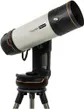 Most light-gathering: 6-inch f/2.2 RASA with a filter drawer, about $4,299Celestron Origin Mark II Intelligent Home Observatory152 mm f/2.2 · 1.32° × 0.75° · 41.6 lb7.5Price tier: FlagshipCheck price
Most people who buy a smart telescope don’t live under dark skies. They live in suburbs and cities, where the sky glows gray-orange and only the brightest stars punch through. The good news is that smart telescopes cope with light pollution better than any eyepiece telescope at the same price. The honest news is that they can’t make it disappear: some targets work well from a city balcony, and some will never look like the photos on the box.
This guide explains the Bortle scale, what you can realistically shoot from Bortle 7–9 skies, why stacking time grows so fast as the sky brightens, and which scopes handle cities best. It’s research-based: we haven’t tested these telescopes ourselves, so where we quote a result we name the outlet. Prices are US Amazon prices on November 12, 2026; check today’s price before you buy.
The Bortle scale in one minute
In 2001 John Bortle published a nine-step darkness scale in Sky & Telescope. S&T’s description puts the naked-eye limiting magnitude of a Class 1 site at 7.6–8.0, and a Class 5 suburb at about 5.6–6.0. By Class 7 the Beehive Cluster and the Andromeda Galaxy can only be glimpsed. In a Class 9 inner city, the Pleiades are about the only Messier object you can see without optics.
You don’t need a meter to find your class. Look up your address on lightpollutionmap.info, then match the color to the table below.
| Class | Sky | mag/arcsec² | What a 30–50 mm smart scope can do |
|---|---|---|---|
| Bortle 1 | Excellent dark sky Remote desert or mountain site; zodiacal light and airglow visible | ~22.0 | Everything on the list is possible; faint galaxies and big H-alpha regions shine. |
| Bortle 2 | Typical truly dark site Remote rural area; Milky Way shows structure | ~21.9 | Faint nebulae and galaxy halos in a session or two. |
| Bortle 3 | Rural sky Some glow on the horizon; Milky Way still complex | ~21.7 | Excellent for nearly every target; the Milky Way casts structure. |
| Bortle 4 | Rural/suburban transition Light domes over towns; Milky Way visible but washed out near the horizon | ~21.1 | Most showpieces in under an hour; faint galaxies need longer. |
| Bortle 5 | Suburban sky Milky Way faint or invisible near the horizon | ~20.0 | Nebulae need a dual-band filter for best results; galaxies take hours. |
| Bortle 6 | Bright suburban sky Milky Way only near the zenith, if at all | ~19.2 | Bright targets fine; faint galaxies become multi-night projects. |
| Bortle 7 | Suburban/urban transition Gray-orange sky; Milky Way invisible | ~18.7 | Moon, planets, clusters and bright nebulae with a filter; galaxies are hard. |
| Bortle 8 | City sky Only bright constellations visible | ~18.2 | Stick to the Moon, Sun, planets, clusters and the brightest nebulae with a dual-band filter. |
| Bortle 9 | Inner-city sky Only the Moon, planets and a few bright stars | ~17.8 | Moon, Sun and planets; a handful of bright nebulae with narrowband filtering. |
Expectations are our editorial summary. Check your own sky with the sky target checker.
Most city apartments sit around Bortle 7–9. Leafy suburbs are often Bortle 5–6. A drive of an hour or so can drop you two or three classes, which matters more than almost any upgrade you can buy.
Why city skies cost you time
A smart telescope takes many short exposures and averages them in real time (we explain it in how smart telescopes work). Averaging reduces random noise, so faint detail slowly climbs out of the background. The problem is that light pollution adds its own noise. The brighter the sky, the more frames you need before a faint nebula stands clear of it.
The numbers add up quickly. Using the typical sky-brightness readings behind the Bortle scale, a Bortle 8 city sky is roughly 14 times brighter than a Bortle 4 rural sky. For a faint target that is fully limited by the sky background, the time needed for the same result scales roughly with that brightness.
Our integration-time estimator models this. For the Pinwheel Galaxy (M101) on a Seestar S50 Pro, it estimates about 2.2 hours from Bortle 4 and about 21 hours from Bortle 8: a realistic evening becomes an unrealistic project. Bright targets suffer far less. The Orion Nebula with the S50 Pro’s built-in dual-band filter comes out at about 5 minutes under Bortle 4 and about 7 minutes under Bortle 8. These are planning estimates, not lab measurements, but the pattern is what city imagers report: bright stays easy, faint gets brutal.
What works from a city
The Moon. Light pollution doesn’t touch it. Craters along the terminator look as sharp from a downtown rooftop as from a mountain, and every smart scope here frames the whole disc.
The Sun. With the right filter fitted, sunspots are just as easy from the city. Seestar and Dwarf models include a solar filter in the box. Read our solar guide before you try.
Star clusters. Open clusters such as the Double Cluster and M35, and globulars such as M13, are mostly bright stars. They show in minutes and look close to the marketing images.
Emission nebulae with a dual-band filter. This is the big one. Nebulae such as Orion (M42), the Rosette and the Lagoon glow in a few narrow colors, mainly hydrogen-alpha and oxygen-III. A dual-band filter passes those colors and blocks most of the rest, including much of the glow from LED streetlights. For the Rosette on a Seestar S50 Pro from Bortle 8, the estimator gives about 2.2 hours with the filter and about 8 hours without it. First Light Optics’ page for the Optolong L-eXtreme shows how tight these filters can get: two 7 nm passbands with nothing transmitted in between.
Planetary nebulae. The Dumbbell (M27) is bright and filter-friendly. Most planetaries are small, though, so expect a colored dot rather than a big picture.
What doesn’t (or barely does)
Faint galaxies. Galaxies shine across the whole spectrum, so a dual-band filter removes their light along with the skyglow. Large, low-surface-brightness galaxies such as the Triangulum (M33) and the Pinwheel are the first things a city sky erases. Compact bright ones, such as the Whirlpool (M51) and the core of Andromeda, still come through with patience.
Reflection nebulae. The blue dust around the Pleiades and nebulae such as M78 reflect starlight. They’re broadband targets, so filters can’t rescue them; from a city, the Pleiades stars show and the nebulosity mostly doesn’t.
Huge, faint hydrogen clouds. The California and Heart nebulae respond to a dual-band filter but are so faint per square arcminute that they become multi-night projects even with one.
Want a verdict for your own sky? The sky target checker set to Bortle 8 sorts dozens of targets by what’s realistic for your scope.
Which smart telescopes handle cities best
The single most useful feature for an urban imager is a built-in dual-band filter, because it costs nothing extra and switches in automatically.
| Telescope | Aperture | Dual-band filter | Solar filter | Price (Nov 12, 2026) |
|---|---|---|---|---|
| Seestar S50 Pro | 50 mm | Built in (OIII 30 nm / H-alpha 20 nm) | Included | ~$999 |
| Dwarf 3 | 35 mm | Built in (OIII 30 nm / H-alpha 15 nm) | Included | ~$549 |
| Seestar S30 Pro | 30 mm | Built in (OIII 30 nm / H-alpha 20 nm) | Included | ~$664 |
| Vespera 3 | 50 mm | Optional extra | Optional | ~$2,490 |
| Origin Mark II | 152 mm | Optional (filter drawer) | None offered | ~$4,299 |
| Unistellar Odyssey | 85 mm | None (software only) | Optional | ~$2,079 |
Seestar S50 Pro: best all-round city scope
The S50 Pro pairs 50 mm of aperture, which collects about 2.8 times the light of the 30 mm Seestars, with a built-in dual-band filter, a solar filter and a carbon tripod in the box. ZWO rates the battery at up to 9 hours. ZWO says it isn’t meant for planets, which is the one city-friendly target class it skips. About $999; check the price.
Dwarf 3: the budget pick
The Dwarf 3 has a slightly narrower H-alpha passband (15 nm) than the Seestars and a 4K Starvis 2 sensor for about $549. Reviewers flag a fiddlier app, and there’s no tripod in the box. It also doubles as a daytime wildlife camera. Check the Dwarf 3 price.
Seestar S30 Pro: balconies and travel
At 1.65 kg, the S30 Pro is easy to carry to a rooftop or a darker site on a weekend, which may help your images more than extra aperture. It has the same built-in duo-band filter plus an anti-dew heater. See our S30 Pro vs S50 Pro comparison if you’re torn.
Celestron Origin Mark II: the heavy hitter
The Origin’s 6-inch f/2.2 RASA collects far more light per pixel than any 30–50 mm scope. The estimator puts the Rosette from Bortle 8 at about 34 minutes on the Origin with a dual-band filter, against about 2.2 hours on the S50 Pro. The catch: it weighs 41.6 lb, costs about $4,299, and its Nebula filter is extra. It has no solar option at all.
Unistellar scopes take a different approach: no physical filter, only software light-pollution reduction. Vaonis sells light-pollution and dual-band filters separately for the Vespera line; Space.com tested the Vespera II from a Bortle 5 town with Vaonis’ filter fitted. Our filter guide covers which add-on fits which scope.
Practical tips for urban observing
- Shoot targets when they’re high. Skyglow and haze are worst near the horizon. A target near its highest point (crossing the meridian) is looking through the least atmosphere and the least city glow.
- Avoid the bright Moon for faint targets. A gibbous or full Moon brightens the whole sky. Use those nights for the Moon itself, clusters or dual-band nebulae, and save galaxies for moonless weeks.
- Get out of direct light. A streetlight shining into the lens adds glare and gradients. Shade the scope with a wall or a dew shield.
- Plan for dew. Cities can be humid at night. The S30 Pro has an anti-dew heater and the Vespera 3 has automatic anti-fog; for others a dew shield helps.
- Bring power. Long city stacks run batteries down. A USB-C power bank keeps 30–50 mm scopes going; check your scope’s manual for supported input first.
- Stack over several nights. If your app supports resuming a target, short sessions across a week add up.
How we chose
We compared all 15 telescopes we track on the features that matter most under bright skies: dual-band filtering, aperture and focal ratio, battery and portability (so you can escape to darker sites). Specs come from maker pages and independent reviews; time estimates come from our integration-time estimator, which uses a background-limited model built on the Bortle scale’s typical sky-brightness values and is guidance, not a measurement. Our full method is on how we research.
Bottom line
A smart telescope is the best way to image from a city, as long as you pick targets the sky allows. Choose a scope with a built-in dual-band filter, start with the Moon, clusters and bright nebulae, and treat faint galaxies as a reason to take a road trip. For most urban stargazers the Seestar S50 Pro is the one to get; check the S50 Pro price. For more first-scope advice, see the best smart telescope for beginners, and for what’s up this season, the best winter targets.
Frequently asked questions
Do smart telescopes work in light-polluted cities?
What is the Bortle scale?
Which smart telescope is best for a city?
Can I photograph galaxies from the city with a smart telescope?
Should I drive to a darker site instead?
Sources
- Sky & Telescope: Light Pollution and Astronomy, the Bortle Dark-Sky Scale (archived) · checked 2026-11-12 — Class 1 skies reach a naked-eye limiting magnitude of 7.6–8.0 and Class 5 about 5.6–6.0; in Class 7 M44 and M31 can only be glimpsed, and in Class 9 the Pleiades are about the only Messier object visible.
- Light Pollution Map · checked 2026-11-12 — Interactive world map of artificial sky brightness that readers can use to estimate their own Bortle class.
- First Light Optics: Optolong L-eXtreme dual band filter · checked 2026-11-12 — The L-eXtreme has two 7 nm passbands at H-alpha and OIII and blocks transmission between H-beta and OIII; it is not for solar use.
- Space.com: DWARFLAB Dwarf Mini review · checked 2026-11-12 — The reviewer used the Dwarf Mini from a Bortle 8 city sky and measured about four hours of battery life.
- Space.com: Vaonis Vespera II review · checked 2026-11-12 — Space.com tested the Vespera II from a Bortle 5 town using Vaonis' optional light-pollution filter.
Get new guides by e-mail
One short e-mail when Smart Telescope Review publishes a new guide. No spam, no sharing your address, and you can unsubscribe in one click.