# What Can I See From My Sky? Smart Telescope Target Checker
> Free smart telescope target checker: pick your Bortle class and a scope to see which of 56 Messier, NGC and solar-system targets are realistic, how they…
- Source: https://smarttelescopereview.com/tools/sky-target-checker/
- Markdown version: https://smarttelescopereview.com/tools/sky-target-checker.md
---
- [Home](https://smarttelescopereview.com/)
- [Tools](https://smarttelescopereview.com/tools/)
- Sky target checker
# What can I see from my sky?
Pick a smart telescope and your Bortle class. We rate 56 popular targets (the Moon, the Sun, planets, Messier and NGC objects) for what that scope can realistically capture from that sky, whether each target fits its field of view, and how long you'd need to stack it.
TelescopeDWARFLAB Dwarf Mini Smart TelescopeZWO Seestar S30 Plus Smart TelescopeZWO Seestar S30 Pro Smart TelescopeDWARFLAB Dwarf 3 Smart TelescopeZWO Seestar S50 Pro Smart TelescopeVaonis Vespera II Smart TelescopeVaonis Vespera 3 Smart TelescopeVaonis Vespera Pro 2 Smart TelescopeUnistellar Odyssey Smart TelescopeUnistellar Odyssey Pro Smart TelescopeUnistellar eQuinox 2 Smart TelescopeUnistellar eVscope 2 Smart TelescopeCelestron Origin Mark II Intelligent Home Observatory
Your sky (Bortle class)1: Excellent dark sky2: Typical truly dark site3: Rural sky4: Rural/suburban transition5: Suburban sky6: Bright suburban sky7: Suburban/urban transition8: City sky9: Inner-city sky
Don't know your class? Find your location on [lightpollutionmap.info](https://www.lightpollutionmap.info/): most suburbs are 5–7, cities 8–9, and rural areas 3–4. If you can see the Milky Way overhead, you're 5 or darker.
Use a dual-band filter on nebulae when the scope has or takes one
## A telescope for your sky
Light pollution changes what matters. One pick for each situation.
- 1Suburbs: built-in dual-band filter[ZWO Seestar S50 Pro Smart Telescope](https://smarttelescopereview.com/smart-telescopes/seestar-s50-pro/)50 mm f/5.2 · 2.45° × 1.38° · 6.2 lb8.6**$$**$$Mid-rangePrice tier: Mid-range[Check price](https://www.amazon.com/dp/B0HP1RDLVP?tag=smarttelescopereview.com-20)
- 2Travel to dark skies: 1.65 kg[ZWO Seestar S30 Pro Smart Telescope](https://smarttelescopereview.com/smart-telescopes/seestar-s30-pro/)30 mm f/5.3 · 3.99° × 2.24° · 3.6 lb8.5**$$**$$Mid-rangePrice tier: Mid-range[Check price](https://www.amazon.com/dp/B0GYX9GSVX?tag=smarttelescopereview.com-20)
- 3Cheapest with a dual-band filter[DWARFLAB Dwarf Mini Smart Telescope](https://smarttelescopereview.com/smart-telescopes/dwarf-mini/)30 mm f/5 · 2.13° × 1.2° · 1.9 lb7.8**$**$$$BudgetPrice tier: Budget[Check price](https://www.amazon.com/dp/B0GT3VFN84?tag=smarttelescopereview.com-20)
- 4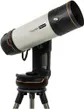Dark backyard: maximum depth[Celestron Origin Mark II Intelligent Home Observatory](https://smarttelescopereview.com/smart-telescopes/celestron-origin-mark-ii/)152 mm f/2.2 · 1.32° × 0.75° · 41.6 lb7.5**$$$$**FlagshipPrice tier: Flagship[Check price](https://www.amazon.com/dp/B0FXYL39P9?tag=smarttelescopereview.com-20)
Affiliate links: we may earn a commission at no cost to you. [Disclosure](https://smarttelescopereview.com/affiliate-disclosure/)
## How to read the results
Each target gets a color-coded verdict. Shows up in minutes means the object appears on your phone almost as soon as stacking starts: the Moon, bright clusters, the Orion Nebula, the Dumbbell. Good in one session means under an hour for a pleasing result. Long session is one to three hours,multi-night project is three to ten hours spread over several nights (Vespera 3 and Pro 2 can resume a stack automatically), and not realistic means more than ten hours from that sky with that scope.
The thumbnail shows the scope's field (blue box) with the target drawn to scale. Big targets such as the Andromeda Galaxy, the North America Nebula or the Heart Nebula overflow small fields and need a mosaic; tiny ones such as the Ring Nebula or planets fill only a few dozen pixels. The [framing calculator](https://smarttelescopereview.com/tools/fov-calculator/) draws one target in every scope's frame side by side.
The Bortle scale and smart telescopes Sky brightness in magnitudes per square arcsecond (higher is darker). Find your class on lightpollutionmap.info.
| Class | Sky | mag/arcsec² | What a 30–50 mm smart scope can do |
| --- | --- | --- | --- |
| Bortle 1 | Excellent dark sky**Remote desert or mountain site; zodiacal light and airglow visible | ~22.0 | Everything on the list is possible; faint galaxies and big H-alpha regions shine. |
| Bortle 2 | Typical truly dark site**Remote rural area; Milky Way shows structure | ~21.9 | Faint nebulae and galaxy halos in a session or two. |
| Bortle 3 | Rural sky**Some glow on the horizon; Milky Way still complex | ~21.7 | Excellent for nearly every target; the Milky Way casts structure. |
| Bortle 4 | Rural/suburban transition**Light domes over towns; Milky Way visible but washed out near the horizon | ~21.1 | Most showpieces in under an hour; faint galaxies need longer. |
| Bortle 5 | Suburban sky**Milky Way faint or invisible near the horizon | ~20.0 | Nebulae need a dual-band filter for best results; galaxies take hours. |
| Bortle 6 | Bright suburban sky**Milky Way only near the zenith, if at all | ~19.2 | Bright targets fine; faint galaxies become multi-night projects. |
| Bortle 7 | Suburban/urban transition**Gray-orange sky; Milky Way invisible | ~18.7 | Moon, planets, clusters and bright nebulae with a filter; galaxies are hard. |
| Bortle 8 | City sky**Only bright constellations visible | ~18.2 | Stick to the Moon, Sun, planets, clusters and the brightest nebulae with a dual-band filter. |
| Bortle 9 | Inner-city sky**Only the Moon, planets and a few bright stars | ~17.8 | Moon, Sun and planets; a handful of bright nebulae with narrowband filtering. |
Expectations are our editorial summary. Check your own sky with the [sky target checker](https://smarttelescopereview.com/tools/sky-target-checker/).
## Realistic expectations vs marketing
Every result carries a "marketing vs reality" line, because the images on listings and boxes are rarely what a first night looks like. Nebula and galaxy photos in ads are typically hours of integration under dark skies; planet close-ups are often cropped or upscaled; prominence images come from hydrogen-alpha solar telescopes rather than the white-light filters smart scopes use. None of that makes smart telescopes a bad buy. They simply reward patience and dark skies like every other telescope. Our [are smart telescopes worth it](https://smarttelescopereview.com/posts/are-smart-telescopes-worth-it/) guide goes deeper.
## How the estimate works
Each target has an editorial difficulty tier, from 1 (showpiece) to 5 (very faint), based on its catalog magnitude, size and average surface brightness, and on the results reviewers and owners typically publish. Magnitudes and sizes are rounded catalog values from the [SEDS Messier data table](http://www.messier.seds.org/data.html) and SEDS NGC/IC pages; surface brightness is computed from magnitude and area. The baseline times assume a Bortle 4 sky and f/5 optics with 2.9 µm pixels.
From there, sky brightness scales the time: in the background-limited regime, the time needed for the same signal-to-noise grows with the sky's brightness, so going from Bortle 4 (about 21.1 mag/arcsec²) to Bortle 8 (about 18.2) multiplies it many times over for faint targets. Bright targets are less sky-limited, so we soften that penalty for them. A dual-band filter removes most of the skyglow for emission nebulae; faster optics (lower f-number) and bigger pixels cut the time. A small aperture penalty applies to small, faint objects.
## A worked example
Take a Seestar S50 Pro in a Bortle 6 suburb, with its built-in dual-band filter on. The Moon, the Pleiades, M13 and the Orion Nebula show up in minutes. The Lagoon Nebula comes out in a single session and the Rosette in a long evening. Andromeda's core is quick, but the full galaxy (about 3° long) is wider than the S50 Pro's 2.45° field, so it needs a two-panel mosaic. The Pinwheel Galaxy (M101), large and faint, becomes a multi-night project. Switch the sky to Bortle 3 and the galaxies move up a level or two; switch the scope to a Seestar S30 Pro and the big nebulae fit in one frame, but small galaxies shrink. That's the whole trade-off of smart telescopes in one screen.
## Frequently asked questions
### What is the Bortle scale?
A nine-step scale of night-sky darkness published by John Bortle in Sky & Telescope in 2001. Class 1 is a pristine dark site where the zodiacal light casts shadows; class 9 is an inner-city sky where only the Moon, planets and a few bright stars show. Most suburbs are class 5–7. You can look up your location on lightpollutionmap.info.
### Can a smart telescope see galaxies from a city?
Bright, compact galaxies such as M81, M82, M51 and the core of Andromeda show up from suburbs in an hour or so. From a Bortle 8–9 city sky galaxies become multi-night projects, because no filter blocks the broadband skyglow they're mixed with. Emission nebulae are different: a dual-band filter keeps them visible even from cities.
### Why do my images look nothing like the marketing photos?
Listing images are usually several hours of data, often from dark sites, sometimes with extra processing on a computer. A 10–20 minute live stack from a suburban backyard is much noisier and less colorful. Our checker estimates what a typical owner gets from a typical sky, and flags the gap target by target.
### Can smart telescopes photograph planets?
Only as small discs. Smart scopes have short focal lengths (150–450 mm), so Jupiter spans roughly 11–48 pixels depending on the scope: enough for its belts and four moons, not for detail. ZWO says its Seestars aren't intended for planets. For planets, a traditional telescope with an eyepiece, or a dedicated planetary camera on a long-focal-length scope, does far better.
### How accurate are the stacking times?
They're planning estimates. We start from an editorial difficulty tier for each target, scale it with sky brightness (brighter skies need proportionally more time for the same signal-to-noise), reduce the sky penalty when a dual-band filter is used on emission nebulae, and adjust for the telescope's focal ratio and pixel size. Haze, the Moon, low altitude and dew all add time.
## Embed this calculator on your site
Free to use: paste this snippet into any web page. It loads a lightweight, ad-free version of the Smart Telescope Sky Target Checker with a visible credit link back to Smart Telescope Review.
Smart Telescope Sky Target Checker by Smart Telescope Review
Copied to clipboard
The credit link is part of the deal: please keep it visible and unchanged so the tool stays free for everyone.